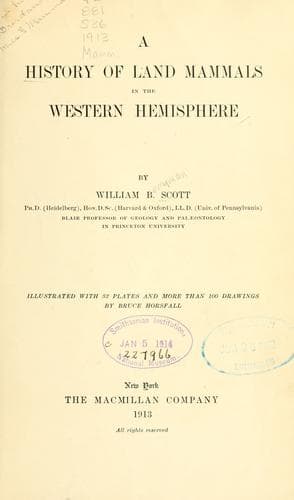
A history of land mammals in the western hemisphereScott, William Berryman
History
A history of land mammals in the western hemisphere
Scott, William Berryman
Mammals; Mammals, Fossil
In view of all these facts, it is not surprising that concerning the
history of many mammalian groups we have but scanty information, or
none at all, while in the case of others the story is wonderfully full
and detailed. The latter are, very generally, the groups which were
not only numerically abundant at all stages of their history, but also
had skeletons that were strong enough to resist destruction; while the
groups as to which there is little or no information are chiefly of
small and fragile animals, or such as were always rare. For example,
a great deal has been learned regarding the development of horses and
rhinoceroses in North America, but the history of the tapirs is very
unsatisfactorily known, because, while horses and rhinoceroses were
common, tapirs were solitary and rare. In Europe bats have been found in
the Eocene, Oligocene and Miocene, and there is no reason to suppose that
they were not equally ancient and equally abundant in America; but none
have been found in the western hemisphere in any formation older than
the Pleistocene. All things considered, the extraordinary fact is, not
that so many forms have irretrievably perished, but that so much has been
preserved, escaping all the chances of destruction.
As to the degree of preservation in fossil mammals, we have to do almost
entirely with bones and teeth. With very rare exceptions, and those
all of late geological date, the viscera, muscles, skin, hair, horns,
hoofs and claws have been completely destroyed and have vanished without
leaving a trace. In northern Siberia the gravel soil is permanently
frozen to a depth of several hundred feet and contains the intact
carcasses of elephants and rhinoceroses of Pleistocene date and notably
different from any species of these animals now in existence. Sometimes
such a carcass is disinterred from a bluff by the cutting action of a
stream and is in a state of nearly complete preservation, with hide,
hair and flesh almost as in an animal freshly killed. From these
remains it has been learned that the †Mammoth was an elephant densely
covered with hair and wool, just as he was depicted in the carvings and
cave-paintings of Pleistocene Man in Europe, where †Mammoth bones have
been abundantly found, and also that there were Siberian rhinoceroses
similarly protected against the cold. †Mammoth remains with hide and
flesh, but much less complete, have likewise been found in Alaska.
Public-domain text, read in full here on John Shaqi.
Reviews
Reviews
No reviews yet
Be the first to share your thoughts on this work.
Join the Discussion
Join the discussion
Sign in to leave a comment or review.
Sign InorCreate an account