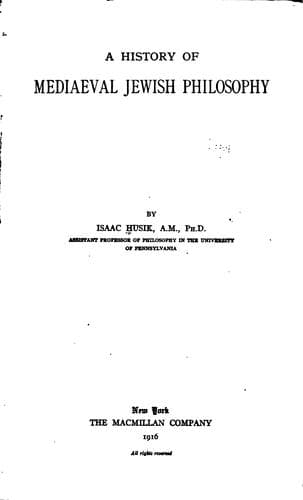
A History of Mediaeval Jewish PhilosophyHusik, Isaac
ReligionJewish
A History of Mediaeval Jewish Philosophy
Husik, Isaac
Philosophy, Jewish; Philosophy, Medieval
wisdom is the form of the soul, and hence the soul does not die like a
body.
The reward of the soul is re-absorption in the world soul of which it is
a part, and the punishment of the unworthy soul that neglected to
acquire knowledge is destruction. What Ibn Ezra means by the Hebrew word
"abad" (ordinarily rendered to perish, to be destroyed) is not clear. It
is hard to see how a pre-existing soul can perish utterly. Rosin
suggests that Ibn Ezra is alluding to transmigration,[217] but it is not
clear.
We have seen that Ibn Ezra holds that the events of the sublunar world
and the destinies of men are governed by the positions and motions of
the heavenly bodies, which in turn are determined by the Intelligences
or angels. The heavenly bodies, he tells us, follow necessary laws
imposed upon them, and are not responsible for any good or evil which
results to mankind from them, since the effects are not of their
intention, and they cannot change them if they would. Accordingly it is
foolish to pray to the heavenly bodies in order to appease them and
prevent evil, as some of the heathen are accustomed to do. The motions
of the heavenly bodies are determined and invariable, and no prayer will
change them. This, however, does not mean to say that no one can escape
the evil which is destined for him in the stars. Ordinarily, it is true,
God does not know the particular individual as such. He knows him only
as implied in the whole, and his destiny is determined accordingly. But
there are exceptions when a person by developing his soul and intellect,
as we saw above, succeeds in his lifetime in separating his soul from
the corporeal and particular, and brings it into contact with the
spiritual and universal. In that case he attracts to himself the special
providence of God, which enables him to evade the evil threatened by his
star, without in any way changing the star's natural course or ordinary
effects. How this is done, Ibn Ezra illustrates by an example.[218]
Suppose, he says, that it is fated according to the stars that a given
city shall be flooded by a river and its inhabitants drowned. A prophet
comes and warns them, urging them to repent of their evil ways before
their fate is sealed. They obey him, return to God with all their heart
and leave the city to offer prayer to God. The river rises in their
absence, as often happens, and floods the city. The wolf is satisfied
and the lamb is whole. The decree of the stars is not interfered with,
and the good man is delivered from evil. In this way Ibn Ezra endeavors
to reconcile natural law (or astrological fatalism) with the ethical
purpose of divine providence. And he also vindicates free will and
responsibility. The rational soul of man has power, he says, to
counteract in part the indications of the stars, though it cannot annul
them entirely. The punishment of the wicked is that they are left
entirely to the fates determined for them by their constellations.
Public-domain text, read in full here on John Shaqi.
Reviews
Reviews
No reviews yet
Be the first to share your thoughts on this work.
Elsewhere in the archive
Join the Discussion
Join the discussion
Sign in to leave a comment or review.
Sign InorCreate an account