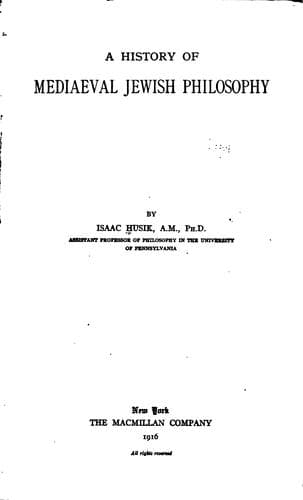
A History of Mediaeval Jewish PhilosophyHusik, Isaac
ReligionJewish
A History of Mediaeval Jewish Philosophy
Husik, Isaac
Philosophy, Jewish; Philosophy, Medieval
We have now completed in outline Saadia's system of Judaism. There are
many details which we necessarily had to leave out, especially in the
more dogmatic part of his work, that dealing with specific Jewish
doctrines, which he constructs on the basis of Rabbinical literature and
Biblical allusions interpreted so as to harmonize with the statements of
the Rabbis. Many questions specifically theological and eschatological
assumed importance in his mind by reason of his surroundings. I mean the
Mohammedan schools and sects, and the Karaite discussions which were
closely modelled after them. The most important part of his system
philosophically is that which deals with creation and the attributes of
God. His discussions of the soul and of free will are less thorough, and
the details of his doctrines of resurrection, future reward and
punishment, the redemption of Israel and the Messiah are almost purely
dogmatic. For a scientific ethic there is no room at all in the body of
his work. A man's conduct is prescribed for him in the divine
commandments, though in a general way the reason sees the right and the
wrong of the so-called rational group of laws. Still as an after thought
Saadia added a chapter to the "Emunot ve-Deot" in which he attempts to
give a psychological basis for human conduct. Noting the various
tendencies of individuals and sects in his environment to extremes in
human behavior, some to asceticism, some to self-indulgence, be it the
lust of love or of power, he lays emphasis on the inadequacy of any one
pursuit for the demands of man's complex nature, and recommends a
harmonious blending of all things for which men strive.[79]
God alone, he says, is a real unity, everything else is by the very
reason of its being a creature essentially not one and simple, but
composite and complex. So man has a love and desire for many things, and
also aversion for many things. And as in other objects in nature it
takes a combination of several elements to constitute a given thing, so
in man it is by a proper systematization of his likes and dislikes that
he can reach perfection of character and morals. It cannot be that God
intended man to pursue one object all his life to the exclusion of all
others, for in that case he would have implanted only one desire in man
instead of many. You cannot build a house of stones alone neither can
you develop a perfect character by one pursuit and one interest.
Public-domain text, read in full here on John Shaqi.
Reviews
Reviews
No reviews yet
Be the first to share your thoughts on this work.
Elsewhere in the archive
Join the Discussion
Join the discussion
Sign in to leave a comment or review.
Sign InorCreate an account