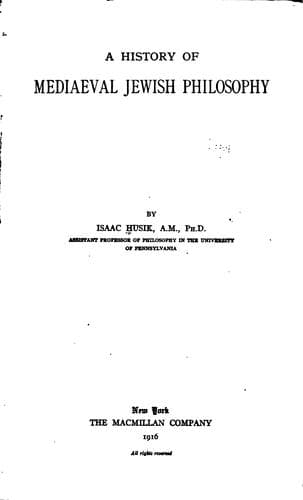
A History of Mediaeval Jewish PhilosophyHusik, Isaac
ReligionJewish
A History of Mediaeval Jewish Philosophy
Husik, Isaac
Philosophy, Jewish; Philosophy, Medieval
Pursuit of one thing is likely to result in harm, for example,
over-indulgence in eating brings on disease. Wisdom is therefore needed
in regulating one's conduct. The principle here is control of one's
likes and dislikes. Of the three faculties of the soul, reason, spirit
and desire, reason must be the master of the other two. If any matter
occurs to a person's imagination, he must try it with his reason to see
whether it is likely to benefit or injure him, and pursue or avoid it
accordingly. If, on the other hand, he allows the lower parts of his
soul to rule his reason, he is not a moral man.
The reader will recognize Plato in the last statement. The division of
the soul into the three faculties of reason, spirit and desire is
Platonic, as we have already seen, and the attempt to base an ethic on
the proper relation between the powers of the soul also goes back to
Plato. But Saadia tries to show that the Bible too favors this
conception.
When Ecclesiastes tells us (1, 14), "I have seen all the works that are
done under the sun; and, behold, all is vanity and a striving after
wind," he does not mean that there is nothing worth striving after, for
he would then be condemning the objects of God's creation. His meaning
is that it is vain to pursue any one thing to the exclusion of every
other. He then proceeds to name three prominent objects of pursuit,
wisdom, pleasure and worldly gain--all is vain when taken by itself. A
proper combination of all is to be recommended as is delicately hinted
in the same book (2, 3), "I searched in mine heart how to cheer my flesh
with wine, mine heart yet guiding me with wisdom, and how to lay hold on
folly."
CHAPTER IV
JOSEPH AL-BASIR AND JESHUA BEN JUDAH
I. _Joseph Al-Basir (11th century)_[80]
Joseph ben Abraham, euphemistically surnamed on account of his
blindness, al-Basir (the seer), was a Karaite and lived in Babylonia or
Persia in the beginning of the eleventh century. His philosophical work
is closely modelled on the writings of the Arabian Mutakallimun, the
Muʿtazilites. Unlike Saadia, who tacitly accepts some of their methods
and views, al-Basir is an avowed follower of the Kalam and treats only
of those questions which are common to Jew and Mohammedan, avoiding, for
example, so important an issue as whether it is possible that the law of
God may be abrogated--a question which meant so much to Saadia. The
division of his investigation into the two parts, Unity and Justice, is
a serious matter with him; and he finds it necessary to tell us in
several instances why he chose to treat a given topic under the one or
the other heading. In spirit and temperament he is a thoroughgoing
rationalist. Brief and succinct to the point of obscurity, he betrays
neither partiality nor emotion, but fearlessly pushes the argument to
its last conclusion and reduces it to its lowest terms.
Public-domain text, read in full here on John Shaqi.
Reviews
Reviews
No reviews yet
Be the first to share your thoughts on this work.
Elsewhere in the archive
Join the Discussion
Join the discussion
Sign in to leave a comment or review.
Sign InorCreate an account