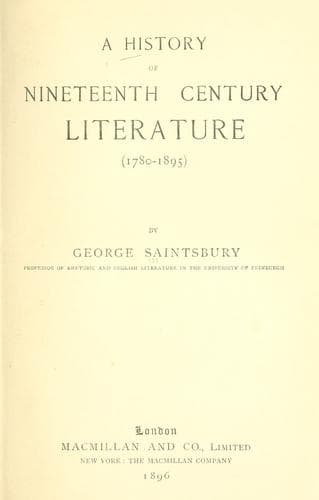
A History of Nineteenth Century Literature (1780-1895)Saintsbury, George
History
A History of Nineteenth Century Literature (1780-1895)
Saintsbury, George
English literature -- 19th century -- History and criticism
It is no doubt true that there is something feminine about the method,
which, with the addition of a certain _nescio quid_, giving it its
modern difference, may be said to combine the peculiarities of Fielding
and of Richardson, though it works on a much smaller scale than either.
It has the intense and pervading, though not the exuberant and
full-blooded, _livingness_ of Fielding, and it also has something not
unlike a feminine counterpart and complement of his pervading irony;
while it is not unlike Richardson in building up the characters and the
stories partly by an infinity of tiny strokes of detail, often
communicated in conversation, partly by the use of an exceedingly nice
and delicate analysis of motive and temperament. It is in the former
respect that Miss Austen stands apart from most, if not from all, women
who have written novels. Irony is by no means a frequent feminine gift;
and as women do not often possess it in any great degree, so they do not
as a rule enjoy it. Miss Austen is only inferior among English writers
to Swift, to Fielding, and to Thackeray--even if it be not improper to
use the term inferiority at all for what is after all not much more than
difference--in the use of this potent but most double-edged weapon. Her
irony indeed is so subtle that it requires a certain dose of subtlety to
appreciate it, and it is not uncommon to find those who consider such
personages as Mr. Collins in _Pride and Prejudice_ to be merely
farcical, instead of, as they are in fact, preachers of the highest and
most Shakespearian comedy. But there would be no room here to examine
Miss Austen's perfections in detail; the important thing for the
purposes of this history is to observe again that she "set the clock,"
so to speak, of pure novel writing to the time which was to be
nineteenth century time to this present hour. She discarded violent and
romantic adventure. She did not rely in the very least degree on
describing popular or passing fashions, amusements, politics; but
confined herself to the most strictly ordinary life. Yet she managed in
some fashion so to extract the characteristics of that life which are
perennial and human, that there never can be any doubt to fit readers in
any age finding themselves at home with her, just as they find
themselves at home with all the greatest writers of bygone ages. And
lastly, by some analogous process she hit upon a style which, though
again true to the ordinary speech of her own day, and therefore now
reviled as "stilted" and formal by those who have not the gift of
literary detachment, again possesses the universal quality, and, save in
the merest externals, is neither ancient nor modern.
Public-domain text, read in full here on John Shaqi.
Reviews
Reviews
No reviews yet
Be the first to share your thoughts on this work.
Elsewhere in the archive
Join the Discussion
Join the discussion
Sign in to leave a comment or review.
Sign InorCreate an account