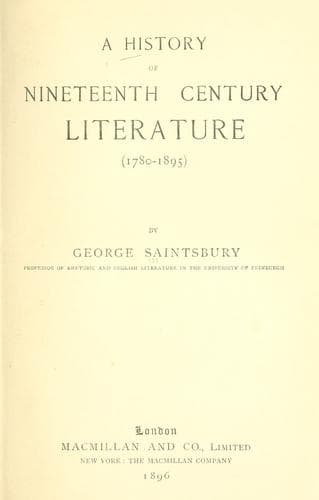
A History of Nineteenth Century Literature (1780-1895)Saintsbury, George
History
A History of Nineteenth Century Literature (1780-1895)
Saintsbury, George
English literature -- 19th century -- History and criticism
Crabbe's position, independently of the strange gap in his publication
(which has been variously accounted for), is not a little singular. The
greater and the better part of his work was composed when the Romantic
revival was in full swing, but it shows little or no trace of the
influence of that revival in versification or diction. His earliest
attempts do indeed show the same reaction from Pope to Dryden (of whom
we know that he was an eager student) which is visible in Cowper and
Churchill; and throughout his work, both earlier and later, there is a
ruthless discarding of conventional imagery and a stern attention to the
realities of scenery and character. But Crabbe has none of the Grace of
the new dispensation, if he has some glimpses of its Law. He sails so
close to the wind of poetry that he is sometimes merely prosaic and
often nearly so. His conception of life is anti-idealist almost to
pessimism, and he has no fancy. The "jewels five words long" are not
his: indeed there clung to him a certain obscurity of expression which
Johnson is said to have good-naturedly smoothed out in his first work to
some extent, but from which he never got quite free. The extravagances
as well as the graces of the new poetry were quite alien from him; its
exotic tastes touched him not; its love for antiquity (though he knew
old English poetry by no means ill) seems to have left him wholly cold.
The anxieties and sufferings of lower and middle-class life, the
"natural death of love" (which, there seems some reason to fear, he had
experienced), the common English country scenery and society of his
time--these were his subjects, and he dealt with them in a fashion the
mastery of which is to this day a joy to all competent readers. No
writer of his time had an influence which so made for truth pure and
simple, yet not untouched by the necessary "disprosing" processes of
art. For Crabbe is not a mere realist; and whoso considers him as such
has not apprehended him. But he was a realist to this extent, that he
always went to the model and never to the pattern-drawing on the Academy
walls. And that was what his time needed. His general characteristics
are extremely uniform: even the external shape and internal
subject-matter of his poems are almost confined to the shape and matter
of the verse-tale. He need not, and indeed cannot, in a book like this,
be dealt with at much length. But he is a very great writer, and a most
important figure at this turning-point of English literature.
Public-domain text, read in full here on John Shaqi.
Reviews
Reviews
No reviews yet
Be the first to share your thoughts on this work.
Join the Discussion
Join the discussion
Sign in to leave a comment or review.
Sign InorCreate an account