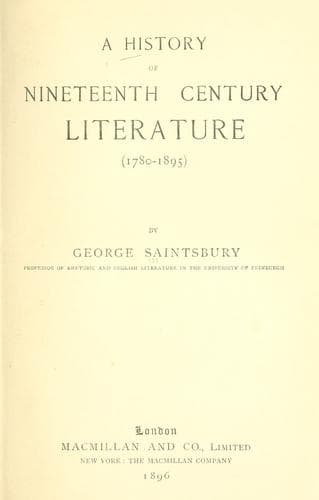
A History of Nineteenth Century Literature (1780-1895)Saintsbury, George
History
A History of Nineteenth Century Literature (1780-1895)
Saintsbury, George
English literature -- 19th century -- History and criticism
Yet, however one may sympathise with Cowper, however much one may admire
Crabbe, it is difficult for any true lover of poetry not to feel the
sense of a "Pisgah sight," and something more, of the promised land of
poetry, in passing from these writers to William Blake and Robert Burns.
Here there is no more allowance necessary, except in the first case for
imperfection of accomplishment, in the second for shortness of life and
comparative narrowness of range. The quality and opportuneness of poetry
are in each case undeniable. Since the deaths of Herrick and Vaughan,
England had not seen any one who had the finer lyrical gifts of the poet
as Blake had them. Since the death of Dunbar, Scotland had not seen such
strength and intensity of poetic genius (joined in this case to a gift
of melody which Dunbar never had) as were shown by Burns. There was
scarcely more than a twelvemonth between their births; for Blake was
born in 1757 (the day appears not to be known), and Burns in January
1759. But Blake long outlived Burns, and did not die till 1828, while
Burns was no more in July 1796. Neither the long life nor the short one
provided any events which demand chronicling here. Both poets were
rather fortunate in their wives, though Blake clave to Catherine Boucher
more constantly than Burns to his Jean. Neither was well provided with
this world's goods; Burns wearing out his short life in difficulties as
farmer and as excise-man, while all the piety of biographers has left it
something of a mystery how Blake got through his long life with no
better resources than a few very poorly paid private commissions for his
works of design, the sale of his hand-made books of poetry and prophecy,
and such occasional employment in engraving as his unconventional style
and his still more unconventional habits and temper allowed him to
accept or to keep. In some respects the two were different enough
according to commonplace standards, less so perhaps according to others.
The forty years of Burns, and the more than seventy of Blake, were
equally passed in a rapture; but morality has less quarrel with Blake,
who was essentially a "God-intoxicated man" and spent his life in one
long dream of art and prophecy, than with Burns, who was generally in
love, and not unfrequently in liquor. But we need no more either of
antithesis or of comparison: the purely literary matter calls us.
Public-domain text, read in full here on John Shaqi.
Reviews
Reviews
No reviews yet
Be the first to share your thoughts on this work.
Join the Discussion
Join the discussion
Sign in to leave a comment or review.
Sign InorCreate an account