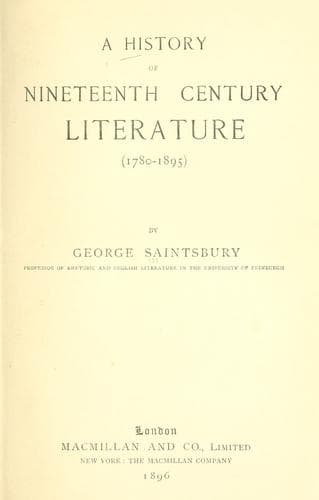
A History of Nineteenth Century Literature (1780-1895)Saintsbury, George
History
A History of Nineteenth Century Literature (1780-1895)
Saintsbury, George
English literature -- 19th century -- History and criticism
of Blake's mystical philosophy, which, borrowing some of its method from
Swedenborg and much of its imagery and nomenclature from _Ossian_,
spreads itself unhampered by any form whatever over the Prophetic
Books. The literary merit of these in parts is often very high, and
their theosophy (for that is the best single word for it) is not seldom
majestic. But despite the attempts of some disciples to evolve a regular
system from them, students of philosophy as well as of literature are
never likely to be at much odds as to their real character. "Ravings"
they are not, and they are very often the reverse of "nonsense." But
they are the work of a man who in the first place was very slightly
acquainted with the literature and antecedents of his subject, who in
the second was distinctly _non compos_ on the critical, though admirably
gifted on the creative side of his brain, and who in the third had the
ill luck to fall under the fullest sway of the Ossianic influence. To
any one who loves and admires Blake--and the present writer deliberately
ranks him as the greatest and most delectable poet of the eighteenth
century proper in England, reserving Burns as specially Scotch--it must
always be tempting to say more of him than can be allowed on such a
scale as the present; but the scale must be observed.
There is all the more reason for the observance that Blake exercised on
the literary _history_ of his time no influence, and occupied in it no
position. He always had a few faithful friends and patrons who kept him
from starvation by their commissions, admired him, believed in him, and
did him such good turns as his intensely independent and rather
irritable disposition would allow. But the public had little opportunity
of seeing his pictures, and less of reading his books; and though the
admiration of Lamb led to some appreciation from Southey and others, he
was practically an unread man. This cannot be said of Robert Burns, who,
born as was said a year or two after Blake, made his first literary
venture three years after him, in 1786. Most people know that the
publication, now famous and costly, called "the Kilmarnock Edition," was
originally issued in the main hope of paying the poet's passage to
Jamaica after an unfortunate youth of struggle, and latterly of
dissipation. Nay, even after the appearance of the _Poems_ and their
welcome he still proposed to go abroad. He was summoned back to
Edinburgh to reprint them, to make a considerable profit by them, and to
be lionised without stint by the society of the Scottish capital. He
then settled down, marrying Jean Armour, at Ellisland in Dumfriesshire,
on a small farm and a post in the Excise, which, when his farming failed
and he moved to Dumfries itself, became his only regular means of
support. He might have increased this considerably by literature; but as
it was he actually gave away, or disposed of for trifling equivalents,
most of the exquisite songs which he wrote in his later years. These
Public-domain text, read in full here on John Shaqi.
Reviews
Reviews
No reviews yet
Be the first to share your thoughts on this work.
Join the Discussion
Join the discussion
Sign in to leave a comment or review.
Sign InorCreate an account