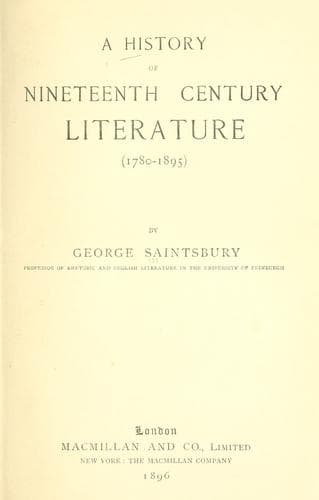
A History of Nineteenth Century Literature (1780-1895) — John Shaqi
A History of Nineteenth Century Literature (1780-1895)Saintsbury, George
History
A History of Nineteenth Century Literature (1780-1895)
Saintsbury, George
English literature -- 19th century -- History and criticism
Unfortunately it was not by any means as a poet that Blake regarded
himself. He knew that he was an artist, and he thought that he was a
prophet; and for the rest of his life, deviating only now and then into
engraving as a mere breadwinner, he devoted himself to the joint
cultivation of these two gifts, inventing for the purpose a method or
vehicle of publication excellently suited to his genius, but in other
respects hardly convenient. This method was to execute text and
illustrations at once on copper-plates, which were then treated in
slightly different fashions. Impressions worked off from these by
hand-press were coloured by hand, Blake and his wife executing the
entire process. In this fashion were produced the lovely little gems of
literature and design called _Songs of Innocence_ (1789) and _Songs of
Experience_ (1794); in this way for the most part, but with some
modifications, the vast and formidable mass of the so-called
"Prophetic" Books. With the artistic qualities of Blake we are not here
concerned, but it is permissible to remark that they resemble his
literary qualities with a closeness which at once explains and is
explained by their strangely combined method of production. That Blake
was not entirely sane has never been doubted except by a few fanatics of
mysticism, who seem to think that the denial of complete sanity implies
a complete denial of genius. And though he was never, in the common
phrase, "incapable of managing" such very modest affairs as were his,
the defect appears most in the obstinate fashion in which he refused to
perfect and co-ordinate his work. He could, when he chose and would give
himself the trouble, draw quite exquisitely; and he always drew with
marvellous vigour and imagination. But he would often permit himself
faults of drawing quite inexplicable and not very tolerable. So, too,
though he had the finest gift of literary expression, he chose often to
babble and still oftener to rant at large. Even the _Songs of Innocence
and Experience_--despite their double charm to the eye and the ear, and
the presence of such things as the famous "Tiger," as the two
"Introductions" (two of Blake's best things), and as "The Little Girl
Lost"--show a certain poetical declension from the highest heights of
the _Poetical Sketches_. The poet is no longer a poet pure and simple;
he has got purposes and messages, and these partly strangle and partly
render turbid the clear and spontaneous jets of poetry which refresh us
in the "Mad Song" and the "Memory." And after the _Songs_ Blake did not
care to put forth anything bearing the ordinary form of poetry. We
possess indeed other poetical work of his, recovered in scraps and
fragments from MSS., and some of it is beautiful. But it is as a rule
more chaotic than the _Sketches_ themselves; it is sometimes defaced
(being indeed mere private jottings never intended for print) by
personality and coarseness; and it is constantly puddled with the jargon
Public-domain text, read in full here on John Shaqi.
Reviews
Reviews
No reviews yet
Be the first to share your thoughts on this work.
Join the Discussion
Join the discussion
Sign in to leave a comment or review.
Sign InorCreate an account