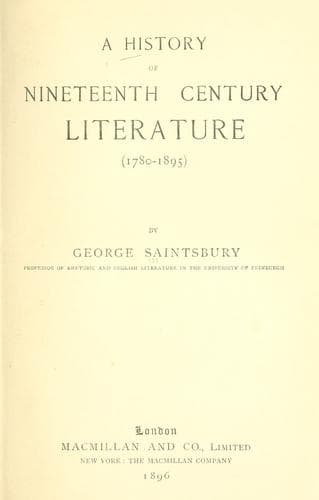
A History of Nineteenth Century Literature (1780-1895)Saintsbury, George
History
A History of Nineteenth Century Literature (1780-1895)
Saintsbury, George
English literature -- 19th century -- History and criticism
moral, argumentative. But what an "only" have we here! It amounts to
this, that Burns could "only" seize, could "only" convey the charms of
poetical expression to, the more primitive thought and feeling of the
natural man, and that he could do this supremely. His ideas are--to use
the rough old Lockian division--ideas of sensation, not of reflection;
and when he goes beyond them he is sensible, healthy, respectable, but
not deep or high. In his own range there are few depths or heights to
which he has not soared or plunged.
That he owed a good deal to his own Scottish predecessors, especially to
Ferguson, is not now denied; and his methods of composing his songs are
very different from those which a lesser man, using more academic forms,
could venture upon without the certainty of the charge of plagiarism. We
shall never understand Burns aright if we do not grasp the fact that he
was a "folk-poet," into whom the soul of a poet of all time and all
space had entered. In all times and countries where folk-poetry has a
genuine existence, its forms and expressions are much less the property
of the individual than of the race. The business of collecting ballads
is one of the most difficult and doubtful, not to say dangerous, open to
the amateur. But it is certain that any collector who was not a mere
simpleton would at once reject as spurious a version which he heard in
identically the same terms from two different subjects. He would know
that they must have got it from a printed or at least written source.
Now Burns is, if not our only example, our only example of the very
first quality, of the poet who takes existing work and hands it on
shaped to his own fashion. Not that he was not perfectly competent to do
without any existing canvas; while, when he had it, he treated it
without the very slightest punctilio. Of some of the songs which he
reshaped into masterpieces for Johnson and Thomson he took no more than
the air and measure; of others only the refrain or the first few lines;
of others again stanzas or parts of stanzas. But everywhere he has
stamped the version with something of his own--something thenceforward
inseparable from it, and yet characteristic of him. In the expression of
the triumph and despair of love, not sicklied over with any thought as
in most modern poets, only Catullus and Sappho can touch Burns. "Green
grow the Rashes O," "Yestreen I had a Pint of Wine," the farewell to
Clarinda, and the famous death-bed verses to Jessie Lewars, make any
advance on them impossible in point of spontaneous and unreflecting
emotion; while a thousand others (the number is hardly rhetorical) come
but little behind. "Willie brew'd a Peck o' Maut" in the same way rides
sovereign at the head of a troop of Bacchanalian verses; and the touches
of rhetoric and convention in "Scots wha hae" cannot spoil, can hardly
even injure it. To some it really seems that the much praised lines "To
Public-domain text, read in full here on John Shaqi.
Reviews
Reviews
No reviews yet
Be the first to share your thoughts on this work.
Join the Discussion
Join the discussion
Sign in to leave a comment or review.
Sign InorCreate an account