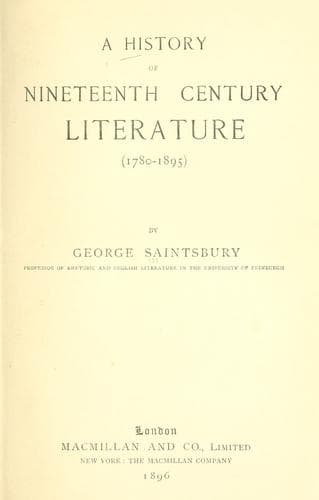
A History of Nineteenth Century Literature (1780-1895)Saintsbury, George
History
A History of Nineteenth Century Literature (1780-1895)
Saintsbury, George
English literature -- 19th century -- History and criticism
Mary in Heaven" and others where the mood is less boisterous, show Burns
at less advantage, not because the kind is inferior, but because he was
less at home in it; but it is almost impossible to praise too highly the
equally famous "Mouse," and some other things. It was in this tremendous
force of natural passion and affection, and in his simple observation of
common things, that Burns' great lesson for his age and country lay.
None even of the reformers had dared to be passionate as yet. In Cowper
indeed there was no passion except of religious despair, in Crabbe none
except that of a grim contemplation of the miseries and disappointments
of life, while although there was plenty of passion in Blake it had all
conveyed itself into the channel of mystical dreaming. It is a little
pathetic, and more than a little curious, to compare "The Star that
shines on Anna's Breast," the one approach to passionate expression of
Cowper's one decided love, with any one of a hundred outbursts of Burns,
sometimes to the very same name.
The other division of the Poems, at the head of which stand _The Jolly
Beggars_, _Tam o' Shanter_, and _The Holy Fair_, exhibit an equal power
of vivid feeling and expression with a greater creative and observant
faculty, and were almost equally important as a corrective and
alterative to their generation. The age was not ill either at drama, at
manners-painting, or at satire; but the special kind of dramatic,
pictorial, and satiric presentation which Burns manifested was quite
unfamiliar to it and in direct contradiction to its habits and
crotchets. It had had a tendency to look only at upper and middle-class
life, to be conventional in its very indecorum, to be ironic, indirect,
parabolical. It admired the Dutch painters, it had dabbled in the
occult, it was Voltairian enough; but it had never dared to outvie
Teniers and Steen as in _The Jolly Beggars_, to blend naturalism and
_diablerie_ with the overwhelming _verve_ of _Tam o' Shanter_, to change
the jejune freethinking of two generations into an outspoken and
particular attack on personal hypocrisy in religion as in _Holy Willie's
Prayer_ and _The Holy Fair_. Even to Scotsmen, we may suspect (or rather
we pretty well know, from the way in which Robertson and Blair, Hume and
Mackenzie, write), this burst of genial racy humour from the _terrae
filius_ of Kilmarnock must have been somewhat startling; and it speaks
volumes for the amiable author of the _Man of Feeling_ that, in the very
periodical where he was wont to air his mild Addisonian hobbies, he
should have warmly commended the Ayrshire ploughman.
Public-domain text, read in full here on John Shaqi.
Reviews
Reviews
No reviews yet
Be the first to share your thoughts on this work.
Join the Discussion
Join the discussion
Sign in to leave a comment or review.
Sign InorCreate an account