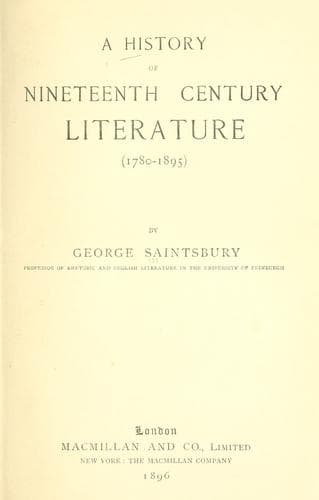
A History of Nineteenth Century Literature (1780-1895)Saintsbury, George
History
A History of Nineteenth Century Literature (1780-1895)
Saintsbury, George
English literature -- 19th century -- History and criticism
it on something like an equality with these, and how on the other hand
he became, as it were, the apostle of the infant Broad Church School
which held aloof alike from Evangelicals and Tractarians, are points
which do not directly concern us. His more than indirect influence on
literature was great; for few schools have contributed to it, in the
same time, a greater number of famous writers than Rugby did under his
head-mastership. His direct connection with it was limited to a fair
number of miscellaneous works, many sermons, an edition of Thucydides,
and a _History of Rome_ which did not proceed (owing to his death in
1842, just after he had been appointed Regius Professor of Modern
History at Oxford) beyond the Second Punic War. Arnold, once perhaps
injudiciously extolled by adoring pupils, and the defender of a theory
of churchmanship which strains rather to the uttermost the principle of
unorthodox economy, has rather sunk between the undying disapproval of
the orthodox and the fact that the unorthodox have long left his
standpoint. But his style is undoubtedly of its own kind scholarly and
excellent; the matter of his history suffers from the common fault of
taking Niebuhr at too high a valuation.
Thomas Babington Macaulay (who may be conveniently discussed before
Carlyle, though he was Carlyle's junior by five years, inasmuch as, even
putting relative critical estimate aside, he died much earlier and
represented on the whole an older style of thought) was born at Rothley
Temple in Leicestershire on 25th October 1800. His father, Zachary
Macaulay, though a very active agitator against the Slave Trade, was a
strong Tory; and the son's conversion to Whig opinions was effected at
some not clearly ascertained period after he had reached manhood. A very
precocious child, he was at first privately educated, but entered
Trinity College, Cambridge, at the age of eighteen. Here he fell in with
a set somewhat but not much less distinguished than that of the famous
time, about ten years later, of which Tennyson was the centre--a set the
most brilliant member of which, besides Macaulay, was the poet Praed.
Praed had been accustomed to journalism before he left Eton, and had
made acquaintance at Windsor with the bookseller Knight, for whose
_Quarterly Magazine_ both he and Macaulay wrote some very good things.
Macaulay himself obtained the Chancellor's prize for English poems on
"Pompeii" and "Evening," in two successive years 1819 and 1820; and
after a very distinguished undergraduate career was elected fellow of
his college. He went to the Bar, and his father's fortune, which had
been a good one, being lost, his chances were for a time uncertain. In
1825, however, he won the admiration of Jeffrey and a place on the
_Edinburgh Review_ by his well-known, and slightly gaudy, but
wonderfully fresh and stimulating article on Milton; and literature,
which had always been his ideal employment, seemed already likely to
Public-domain text, read in full here on John Shaqi.
Reviews
Reviews
No reviews yet
Be the first to share your thoughts on this work.
Elsewhere in the archive
Join the Discussion
Join the discussion
Sign in to leave a comment or review.
Sign InorCreate an account