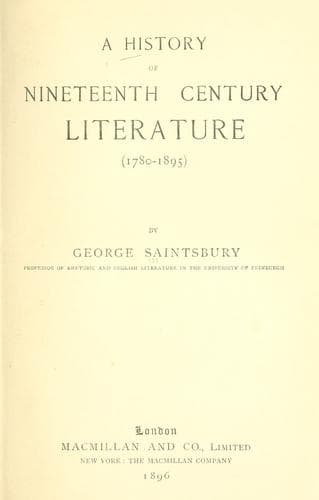
A History of Nineteenth Century Literature (1780-1895)Saintsbury, George
History
A History of Nineteenth Century Literature (1780-1895)
Saintsbury, George
English literature -- 19th century -- History and criticism
yield him a fair subsistence--for review-writing was at that time much
more highly paid than it is at present. Moreover the Whigs, on the eve
of their long postponed triumph, were looking out for young men of
talent; and Macaulay, being recruited by them, was put into Lord
Lansdowne's pocket-borough of Calne. In the Reform debates themselves he
distinguished himself greatly, and after the Bill was carried, having
been elected for Leeds, he was not long in receiving his reward. It was
munificent, for he, a man of little more than thirty, who had made no
reputation at the Bar, though much elsewhere, was appointed Legal Member
of Council in India with a salary very much of which could in those days
be saved by a careful man, especially if, like Macaulay, he was
unmarried. Accordingly when, after between four and five years' stay,
Macaulay in 1838 returned home, he was in possession of means sufficient
to enable him to devote himself without fear or hindrance to literary
and political pursuits, while his fame had been raised higher during his
absence by his contributions to the _Edinburgh Review_. Indeed his
Indian experiences furnished the information--erroneous in some cases
and partisan in others, but brilliantly used--enabling him to write the
famous essays on Clive and on Hastings, where his historical method is
at almost its best. He was elected member for Edinburgh, a very high
compliment, in 1839; and next year became Secretary for War. In 1842 and
1843 respectively he established his position in verse and prose by
publishing the _Lays of Ancient Rome_ and a collection of his _Essays_;
and in 1846 he was made Postmaster-General. But his support of the
Maynooth Grant offended the Protestantism of his constituents, and he
lost his seat, and for the time his political opportunities, in 1847.
The disaster was no disaster for literature: he had long been employed
on a _History of England from the Accession of James II._, and being now
able to devote his whole time to it, he published the first volumes in
1848 with astonishing success.
He was re-elected for Edinburgh in 1852, published the third and fourth
volumes of his History in 1855 with success greater in pecuniary ways
and otherwise than even that of their forerunners, was raised to the
Upper House as Lord Macaulay of Rothley in 1857, and died two years
later, on 28th December 1859, of heart disease. Some personal
peculiarities of Macaulay's--his extraordinary reading and memory, his
brilliant but rather tyrannical conversation, his undoubting
self-confidence--were pretty well known in his lifetime, and did not
always create a prejudice in his favour. But a great revolution in this
respect was brought about by the _Life_ of him, produced a good many
years later by his nephew, Sir George Trevelyan--a Life, standing for
the interest of its matter and the skill and taste of its manner, not
too far below the masterpieces of Boswell and Lockhart.
Public-domain text, read in full here on John Shaqi.
Reviews
Reviews
No reviews yet
Be the first to share your thoughts on this work.
Elsewhere in the archive
Join the Discussion
Join the discussion
Sign in to leave a comment or review.
Sign InorCreate an account