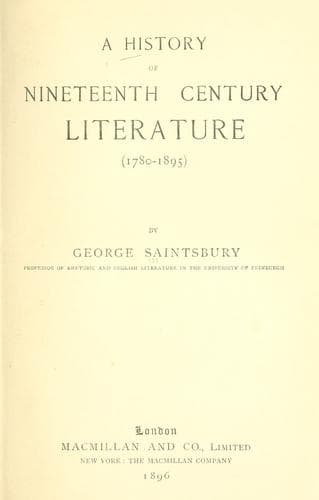
A History of Nineteenth Century Literature (1780-1895)Saintsbury, George
History
A History of Nineteenth Century Literature (1780-1895)
Saintsbury, George
English literature -- 19th century -- History and criticism
where the image of a guardian angel holding Peace with the firmness of
an Irish housewife, and plucking her steadily in order to line a nuptial
crown (which must have been a sort of sun-bonnet) with the down thereof,
will probably be admitted to be not easily surpassable. Of Hayley's
companions in song, I have been dispensed by my predecessor from
troubling myself with Erasmus Darwin, who was perhaps intellectually the
ablest of them, though the extreme absurdity of the scheme of his
_Botanic Garden_ brought him, as the representative of the whole school,
under the lash of the _Anti-Jacobin_ in never-dying lines. Darwin's
friend and townswoman, Anna Seward; Mrs. Barbauld, the author of the
noble lines, "Life, we've been long together"--the nobility of which is
rather in its sentiment than in its expression--and of much tame and
unimportant stuff; Merry, who called himself Della Crusca and gathered
round him the school of gosling imitators that drew on itself the lash
of Gifford; the Laureate Pye; and others who, less fortunate than the
victims of Canning and Frere, have suffered a second death in the
forgetting of the very satires in which they met their deserts, can be
barely named now. Two, however, may claim, if no great performance, a
remarkable influence on great performers. Dr. Sayers, a member of the
interesting Norwich school, directly affected Southey, and not Southey
only, by his unrhymed verse; while the sonnets of William Lisle Bowles,
now only to be read with a mild esteem by the friendliest critic most
conscious of the historic allowance, roused Coleridge to the wildest
enthusiasm and did much to form his poetic taste. To Bowles, and perhaps
to one or two others, we may find occasion to return hereafter.
The satires, however, which have been more than once referred to in the
preceding paragraph, form a most important feature, and a perhaps almost
more important symptom, of the literary state of the time. They show,
indeed, that its weakness did not escape the notice of contemporaries;
but they also show that the very contemporaries who noticed it had
nothing better to give in the way of poetry proper than that which they
satirised. In fact, one of the chief of these satirists, Wolcot, has
left a considerable mass of not definitely satirical work which is
little if at all better than the productions of the authors he
lampooned.
Public-domain text, read in full here on John Shaqi.
A History of Nineteenth Century Literature (1780-1895) — John Shaqi
Reviews
Reviews
No reviews yet
Be the first to share your thoughts on this work.
Join the Discussion
Join the discussion
Sign in to leave a comment or review.
Sign InorCreate an account