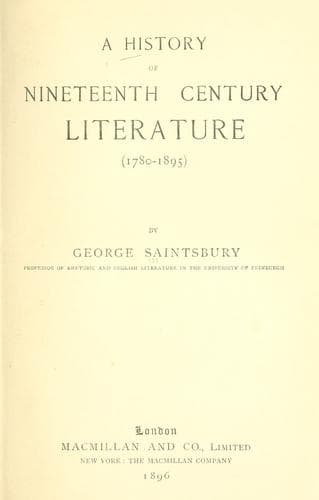
A History of Nineteenth Century Literature (1780-1895) — John Shaqi
A History of Nineteenth Century Literature (1780-1895)Saintsbury, George
History
A History of Nineteenth Century Literature (1780-1895)
Saintsbury, George
English literature -- 19th century -- History and criticism
This very remarkable body of satirical verse, which extends from the
_Rolliad_ and the early satires of Peter Pindar at the extreme beginning
of our present time to the _Pursuits of Literature_ and the
_Anti-Jacobin_ towards its close, was partly literary and partly
political, diverging indeed into other subjects, but keeping chiefly to
these two and intermixing them rather inextricably. The _Pursuits of
Literature_, though mainly devoted to the subject of its title, is also
to a great extent political; the _Rolliad_ and the _Probationary Odes_,
intensely political, were also to no small extent literary. The chief
examples were among the most popular literary productions of the time;
and though few of them except the selected _Poetry of the Anti-Jacobin_
are now read, almost all the major productions deserve reading. The
great defect of contemporary satire--that it becomes by mere lapse of
time unintelligible--is obviated to no small extent here by the crotchet
(rather fortunate, though sometimes a little tedious) which these
writers, almost without exception, had for elaborate annotation. Of the
chief of them, already indicated more than once by reference or
allusion, some account may be given.
_The Rolliad_ is the name generally given for shortness to a collection
of political satires originating in the great Westminster election of
1784, when Fox was the Whig candidate. It derived its name from a
Devonshire squire, Mr. Rolle, who was a great supporter of Pitt; and,
with the _Political Eclogues_, the mock _Probationary Odes_ for the
laureateship (vacant by Whitehead's death), and the _Political
Miscellanies_, which closed the series, was directed against the young
Prime Minister and his adherents by a knot of members of Brooks' Club,
who are identified rather by tradition and assertion than by positive
evidence. Sheridan, Tierney, Burgoyne, Lord John Townshend, Burke's
brother Richard, and other public men probably or certainly contributed,
as did Ellis--afterwards to figure so conspicuously in the same way on
the other side. But the chief writers were a certain Dr. Lawrence, a
great friend of Burke, who was in a way the editor; Tickel, a descendant
of Addison's friend and a connection of the Sheridans; and another
Irishman named Fitzpatrick. The various "skits" of which the book or
series is composed show considerable literary skill, and there is a
non-political and extraneous interest in the fact that it contains some
_rondeaux_ believed to be the only, or almost the only, examples of that
form written in England between Cotton in the seventeenth century and
the revival of it not very many years ago. The fun is often very good
fun, and there is a lightness and brightness about the verse and
phrasing which had been little seen in English since Prior. But the tone
is purely personal; there are no principles at stake, and the book,
besides being pretty coarse in tone, is a sort of object lesson in the
Public-domain text, read in full here on John Shaqi.
Reviews
Reviews
No reviews yet
Be the first to share your thoughts on this work.
Join the Discussion
Join the discussion
Sign in to leave a comment or review.
Sign InorCreate an account