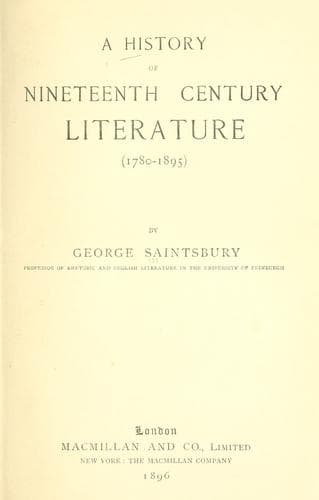
A History of Nineteenth Century Literature (1780-1895)Saintsbury, George
History
A History of Nineteenth Century Literature (1780-1895)
Saintsbury, George
English literature -- 19th century -- History and criticism
Gifford and Mathias differ from the others just mentioned in being less
directly political in writing and inspiration, though Gifford at least
was a strong politician. He was, like Wolcot, a Devonshire man, born at
Ashburton in 1757, and, as his numerous enemies and victims took care
often to remind him, of extremely humble birth and early breeding,
having been a shoemaker's apprentice. Attracting attention as a clever
boy, he was sent to Exeter College and soon attained to influential
patronage. To do him justice, however, he made his reputation by the
work of his own hand,--his satires of _The Baviad_, 1794, and _The
Maeviad_ next year, attacking and pretty nearly extinguishing Merry and
his Della Cruscans, a set of minor bards and mutual admirers who had
infested the magazines and the libraries for some years.[1] The
_Anti-Jacobin_ and the editing of divers English classics put Gifford
still higher; and when the _Quarterly Review_ was established in
opposition to the _Edinburgh_, his appointment (1809) to the editorship,
which he held almost till his death (he gave it up in 1824 and died in
1826), completed his literary position. Gifford is little read nowadays,
and a name which was not a very popular one even on his own side during
his lifetime has, since the triumph of the politics and of some of the
literary styles which he opposed, become almost a byword for savage and
unfair criticism. The penalty of unfairness is usually and rightly paid
in kind, and Gifford has paid it very amply. The struggles of his youth
and lifelong ill-health no doubt aggravated a disposition at no time
very sweet; and the feuds of the day, both literary and political, were
apt to be waged, even by men far superior to Gifford in early and
natural advantages, with the extremest asperity and without too much
scruple. But Gifford is perhaps our capital example in English of a cast
of mind which is popularly identified with that of the critic, though in
truth nothing is more fatal to the attainment of the highest critical
competence. It was apparently impossible for him (as it has been, and,
it would seem, is for others,) to regard the author whom he was
criticising, the editor who had preceded him in his labours, or the
adversary with whom he was carrying on a polemic, as anything but a
being partly idiotic and partly villainous, who must be soundly scolded,
first for having done what he did, and secondly to prevent him from
doing it again. So ingrained was this habit in Gifford that he could
refrain from indulging it, neither in editing the essays of his most
distinguished contributors, nor in commenting on the work of these
contributors, outside the periodicals which he directed. Yet he was a
really useful influence in more ways than one. The service that he did
in forcibly suppressing the Della Cruscan nuisance is even yet admitted,
and there has been plentiful occasion, not always taken, for similar
literary _dragonnades_ since.
Public-domain text, read in full here on John Shaqi.
Reviews
Reviews
No reviews yet
Be the first to share your thoughts on this work.
Join the Discussion
Join the discussion
Sign in to leave a comment or review.
Sign InorCreate an account