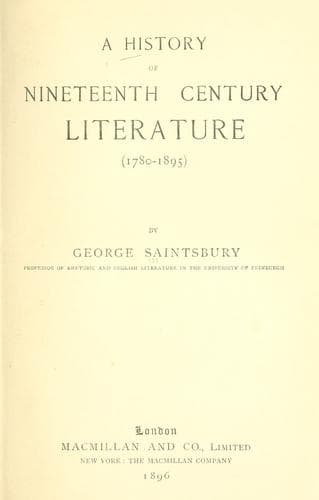
A History of Nineteenth Century Literature (1780-1895)Saintsbury, George
History
A History of Nineteenth Century Literature (1780-1895)
Saintsbury, George
English literature -- 19th century -- History and criticism
And his work as an editor of English
classics was, blemishes of manner and temper excepted, in the main very
good work.
Thomas James Mathias, the author of _The Pursuits of Literature_, was a
much nearer approach to the pedant pure and simple. For he did not, like
Gifford, redeem his rather indiscriminate attacks on contemporaries by a
sincere and intelligent devotion to older work; and he was, much more
than Gifford, ostentatious of such learning as he possessed. Accordingly
the immense popularity of his only book of moment is a most remarkable
sign of the times. De Quincey, who had seen its rise and its fall,
declares that for a certain time, and not a very short one, at the end
of the last century and the beginning of this, _The Pursuits of
Literature_ was the most popular book of its own day, and as popular as
any which had appeared since; and that there is not very much hyperbole
in this is proved by its numerous editions, and by the constant
references to it in the books of the time. Colman, who was one of
Mathias' victims, declared that the verse was a "peg to hang the notes
on"; and the habit above referred to certainly justified the gibe to no
small extent. If the book is rather hard reading nowadays (and it is
certainly rather difficult to recognise in it even the "demon of
originality" which De Quincey himself grants rather grudgingly as an
offset to its defects of taste and scholarship), it is perhaps chiefly
obscured by the extreme desultoriness of the author's attacks and the
absence of any consistent and persistent target. Much that Mathias
reprehends in Godwin and Priestley, in Colman and Wolcot, and a whole
crowd of lesser men, is justifiably censured; much that he lays down is
sound and good enough. But the whole--which, after the wont of the time,
consists of several pieces jointed on to each other and all flooded with
notes--suffers from the twin vices of negation and divagation. Indeed,
its chief value is that, both by its composition and its reception, it
shows the general sense that literature was not in a healthy state, and
that some renaissance, some reaction, was necessary.
Public-domain text, read in full here on John Shaqi.
Reviews
Reviews
No reviews yet
Be the first to share your thoughts on this work.
Join the Discussion
Join the discussion
Sign in to leave a comment or review.
Sign InorCreate an account