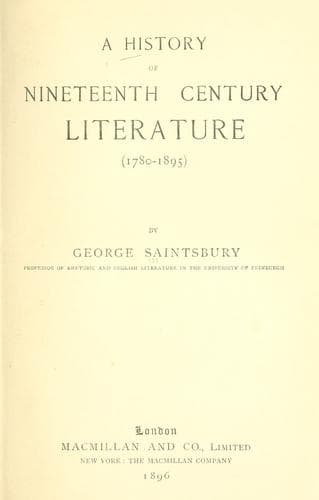
A History of Nineteenth Century Literature (1780-1895)Saintsbury, George
History
A History of Nineteenth Century Literature (1780-1895)
Saintsbury, George
English literature -- 19th century -- History and criticism
The period of English literary history which is dealt with in the
opening part of the present volume includes, of necessity, among its
most illustrious names, not a few whose work will not be the subject of
formal discussion here, because the major part of it was done within the
scope of the volume which preceded. Thus, to mention only one of these
names, the most splendid displays of Burke's power--the efforts in which
he at last gave to mankind what had previously been too often devoted to
party--date from this time, and even from the later part of it; while
Gibbon did not die till 1794, and Horace Walpole not till 1797. Even
Johnson, the type and dictator at once of the eighteenth century in
literary England, survived the date of 1780 by four years.
Nevertheless the beginning of the ninth decade of the century did
actually correspond with a real change, a real line of demarcation. Not
only did the old writers drop off one by one, not only did no new
writers of utterly distinct idiosyncrasy (Burns and Blake excepted) make
their appearance till quite the end of it, but it was also marked by the
appearance of men of letters and of literary styles which announced, if
not very distinctly, the coming of changes of the most sweeping kind.
Hard as it may be to exhibit the exact contrast between, say, Goldsmith
and men like Cowper on the one side and Crabbe on the other, that
contrast cannot but be felt by every reader who has used himself in the
very least to the consideration of literary differences. And as with
individuals, so with kinds. No special production of these twenty years
may be of the highest value; but there is a certain idiosyncrasy, if
only an idiosyncrasy of transition--an unlikeness to anything that comes
before, and to anything, unless directly imitated, that comes
after--which is equally distinguishable in the curious succession of
poetical satires from Peter Pindar to the _Anti-Jacobin_, in the
terror-and-mystery novels of the school of Mrs. Radcliffe and Monk
Lewis, in the large, if not from the literary point of view extremely
noteworthy, department of politics and economics which in various ways
employed the pens of writers so different as Moore, Young, Godwin,
Priestley, Horne, Tooke, Cobbett, and Paine.
Public-domain text, read in full here on John Shaqi.
Reviews
Reviews
No reviews yet
Be the first to share your thoughts on this work.
Join the Discussion
Join the discussion
Sign in to leave a comment or review.
Sign InorCreate an account