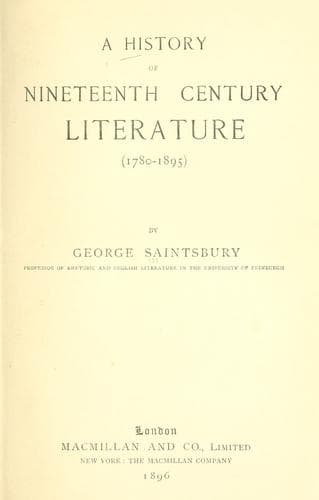
A History of Nineteenth Century Literature (1780-1895)Saintsbury, George
History
A History of Nineteenth Century Literature (1780-1895)
Saintsbury, George
English literature -- 19th century -- History and criticism
Giving poetry, as usual, the precedence even in the most unpoetical
periods, we shall find in the four names already cited--those of Crabbe,
Cowper, Blake, and Burns--examples of which even the most poetical
period need not be ashamed. In what may be called the absolute spirit of
poetry, the _nescio quid_ which makes the greatest poets, no one has
ever surpassed Burns and Blake at their best; though the perfection of
Burns is limited in kind, and the perfection of Blake still more limited
in duration and sustained force. Cowper would have been a great poet of
the second class at any time, and in some times might have attained the
first. As for Crabbe, he very seldom has the absolute spirit of poetry
just mentioned; but the vigour and the distinction of his verse, as well
as his wonderful faculty of observation in rendering scene and
character, are undeniable. And it is not perhaps childish to point out
that there is something odd and out of the way about the poetical career
of all these poets of the transition. Cowper's terrible malady postpones
his first efforts in song to an age when most poets are losing their
voices; Crabbe, beginning brilliantly and popularly, relapses into a
silence of nearly a quarter of a century before breaking out with
greater power and skill than ever; Burns runs one of the shortest, if
one of the most brilliant, Blake one of the longest, the strangest, the
most intermittent, of poetical careers. Nor is it superfluous to draw
attention further to the fact that when we leave this little company--at
the best august, at the worst more than respectable--we drop suddenly to
the flattest and most hopeless bog of poesiless verse that lies anywhere
on the map of England's literature. Passing from the ethereal music of
the Scottish ploughman and the English painter, from Cowper's noble or
gentle thought and his accomplished versification, from Crabbe's manly
vigour and his Rembrandt touch, we find nothing, unless it be the
ingenious but not strictly poetical burlesque of the Wolcots and the
Lawrences, till we come to the drivel of Hayley and the drought of
Darwin.
Public-domain text, read in full here on John Shaqi.
Reviews
Reviews
No reviews yet
Be the first to share your thoughts on this work.
Join the Discussion
Join the discussion
Sign in to leave a comment or review.
Sign InorCreate an account