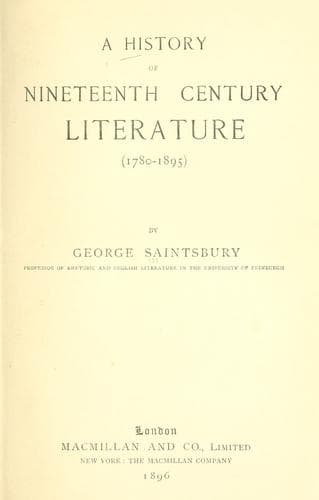
A History of Nineteenth Century Literature (1780-1895) — John Shaqi
A History of Nineteenth Century Literature (1780-1895)Saintsbury, George
History
A History of Nineteenth Century Literature (1780-1895)
Saintsbury, George
English literature -- 19th century -- History and criticism
universality in their hunt after personal conceits; the latter neglect
it in the endeavour to add nothing to rigidly elaborated personal
sensation. The one kind outstrips nature; the other comes short of art.
From Dryden to Cowper the fault was different from both of these. It
neglected the personal impression and the attention to nature too much.
It dared not present either without stewing them in a sauce of stock
ideas, stock conventions, stock words and phrases, which equally missed
the universal and the particular. Cowper and the other great men who
were his contemporaries by publication if not by birth, set to work to
cure this fault. Even the weakest of them could never have been guilty
of such a passage as that famous one which Congreve (as clever a man as
any) wrote, and which Johnson (as clever a man as any) admired. The
sentiment which actuated them was, if we may trust Coleridge's account
of Boyer or Bowyer, the famous tyrant of Christ's Hospital, well
diffused. "'Nymph,' boy? You mean your nurse's daughter," puts in a
somewhat brutal and narrow form the correction which the time needed,
and which these four in their different ways applied.
We have already glanced at the way in which Cowper applied it in his
larger poems: he did it equally well, and perhaps more tellingly, in his
smaller. The day on which a poet of no mean pretensions, one belonging
altogether to the upper classes of English society, and one whose lack
of university education mattered the less because the universities were
just then at their nadir, dared to write of the snake he killed
"And taught him never to come there no more"
was an epoch-making day. Swift would have done it; but Swift was in many
ways a voice crying in the wilderness, and Swift was not, strictly
speaking, a poet at all. Byrom would have done it; but Byrom was
emphatically a minor poet. Cowper could--at least in and for his
day--boast the major afflatus, and Cowper did not disdain vernacular
truth. He never could have been vulgar; there is not in the whole range
of English literature quite such a gentleman in his own way as Cowper.
But he has escaped almost entirely from the genteel style--from the
notion of things as below the dignity of literature.
Public-domain text, read in full here on John Shaqi.
Reviews
Reviews
No reviews yet
Be the first to share your thoughts on this work.
Join the Discussion
Join the discussion
Sign in to leave a comment or review.
Sign InorCreate an account