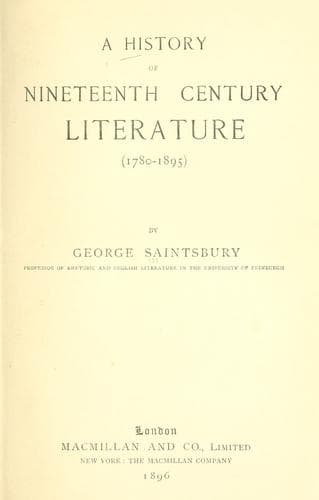
A History of Nineteenth Century Literature (1780-1895) — John Shaqi
A History of Nineteenth Century Literature (1780-1895)Saintsbury, George
History
A History of Nineteenth Century Literature (1780-1895)
Saintsbury, George
English literature -- 19th century -- History and criticism
Cowper, even more than most writers, deserves and requites consideration
under the double aspect of matter and form. In both he did much to alter
the generally accepted conditions of English poetry; and if his formal
services have perhaps received less attention than they merit, his
material achievements have never been denied. His disposition--in which,
by a common enough contrast, the blackest and most hopeless melancholy
was accompanied by the merriest and most playful humour--reflected
itself unequally in his verse, the lighter side chiefly being exhibited.
Except in "The Castaway," and a few--not many--of the hymns, Cowper is
the very reverse of a gloomy poet. His amiability, however, could also
pass into very strong moral indignation, and he endeavoured to give
voice to this in a somewhat novel kind of satire, more serious and
earnest than that of Pope, much less political and personal than that of
Dryden, lighter and more restrained than that of the Elizabethans. His
own unworldly disposition, together with the excessively retired life
which he had led since early manhood, rather damaged the chances of
Cowper as a satirist. We always feel that his censure wants actuality,
that it is an exercise rather than an experience. His efforts in it,
however, no doubt assisted, and were assisted by, that alteration of
the fashionable Popian couplet which, after the example partly of
Churchill and with a considerable return to Dryden, he attempted, made
popular, and handed on to the next generation to dis-Pope yet further.
This couplet, paralleled by a not wholly dissimilar refashioning of
blank verse, in which, though not deserting Milton, he beat out for
himself a scheme quite different from Thomson's, perhaps show at their
best in the descriptive matter of _The Task_ and similar poems. It was
in these that Cowper chiefly displayed that faculty of "bringing back
the eye to the object" and the object to the eye, in which he has been
commonly and justly thought to be the great English restorer. Long
before the end of the Elizabethan period, poetical observation of nature
had ceased to be just; and, after substituting for justness the wildest
eccentricities of conceit, it went for a long time into another
extreme--that of copying and recopying certain academic
conventionalities, instead of even attempting the natural model. It is
not true, as Wordsworth and others have said, that Dryden himself could
not draw from the life. He could and did; but his genius was not
specially attracted to such drawing, his subjects did not usually call
for it, and his readers did not want it. It is not true that Thomson
could not "see"; nor is it true of all his contemporaries and immediate
followers that they were blind. But the eighteenth century had slipped
into a fault which was at least as fatal as that of the
Idealist-Impressionists of the seventeenth, or as that of the
Realist-Impressionists of our own time. The former neglected
Public-domain text, read in full here on John Shaqi.
Reviews
Reviews
No reviews yet
Be the first to share your thoughts on this work.
Join the Discussion
Join the discussion
Sign in to leave a comment or review.
Sign InorCreate an account