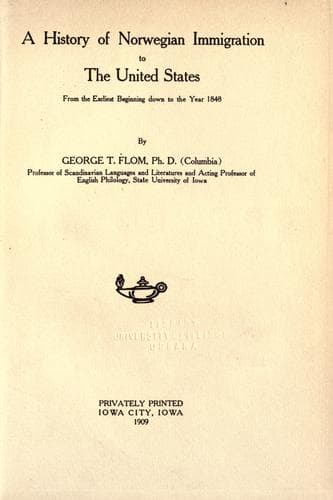
A History of Norwegian Immigration to the United States: From the Earliest Beginning down to the Year 1848 — John Shaqi
A History of Norwegian Immigration to the United States: From the Earliest Beginning down to the Year 1848Flom, George T. (George Tobias)
History
A History of Norwegian Immigration to the United States: From the Earliest Beginning down to the Year 1848
Flom, George T. (George Tobias)
Norwegians -- United States
Immigration from Norway resulted in the founding of settlements in
New York, Illinois, Wisconsin and Iowa successively; I shall try to
give a correct narrative of the beginnings and the growth of these
settlements. In this part of the work I shall stress the oldest and
largest settlements in Southern Wisconsin and Northern Illinois, for
the relation of these to the whole movement and later colonization
of the Northwestern States by the Norwegians is one of especial
importance. I shall treat somewhat fully of the causes of emigration,
of the growth of the movement, and the part in it that each district
or province in Norway has played. The leaders from each district
and the founders of the settlements here will be named and in many
cases, sketches will be given of their lives. Such questions as the
course of the movement in Norway, the cost of the voyage, the course
of the journey, early wage conditions, the economic conditions of
the immigrants, the geographical trend of settlement, will also be
considered, and approximately complete lists of the accessions in each
settlement for the first few years will be given. The limits of this
volume, however, will preclude the treatment of social or cultural
questions, or to take more than the briefest notice of the pursuits and
occupations of the Norwegian-American and his contribution to American
life. I hope to be able to treat elsewhere, later, of some of these
problems.
The story of the immigrant settler is one that is well worth the
telling; it is one that is justly receiving increased attention in
recent years. I believe that the writer of American history will, in
the future, pay far greater attention than he has in the past to the
immigrant pioneer as a factor in the development of the nation. There
are in America today about one million people of Norwegian birth, or
Norwegian parentage. That is, there are nearly half as many of that
nationality in America as in Norway itself. The transplanting of so
large a proportion of a race from the land to which it is rooted by
birth and by its history is indeed remarkable.
Various European peoples have contributed to the growth of the
American population; they have each given something to the sum total
of present American life and in some measure helped to shape American
institutions. As a people America is yet in the formative period;
racially, at least, one-half of the population is not Anglo-Saxon.
It is by the amalgamation of all its ethnic factors that the future
American people will be evolved. The contribution that each foreign
element will make to that evolution will be determined by the
civilization, which each represents as its racial heritage, the culture
which, in the course of its history, each has evolved as a people
and a nation. As the true student of American history takes note of
these things in the future, the significance of the foreign factor in
the growth and the upbuilding of the country will receive its just
recognition.
Public-domain text, read in full here on John Shaqi.
Reviews
Reviews
No reviews yet
Be the first to share your thoughts on this work.
Join the Discussion
Join the discussion
Sign in to leave a comment or review.
Sign InorCreate an account