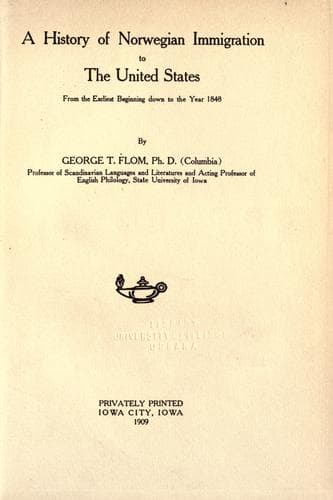
A History of Norwegian Immigration to the United States: From the Earliest Beginning down to the Year 1848Flom, George T. (George Tobias)
History
A History of Norwegian Immigration to the United States: From the Earliest Beginning down to the Year 1848
Flom, George T. (George Tobias)
Norwegians -- United States
We of Norse blood, but American birth, if we are true to the best
that is in us, cannot fail to have an interest in the trials and
the achievements of the pioneer fathers. We must recognize the true
heroism of the men and women who braved the hardships and suffered
the privations of frontier life in the thirties, the forties and
the fifties. The part that the pioneers of those days played in the
development of the Northwest was a great one; in comparison with it
that of the present generation is wholly insignificant. It is to the
memory of those pioneers, in recognition of their true worth, that this
record of their coming is dedicated.
CHAPTER I
_Norway: Population, Resources, Pursuits of her
People, Social Conditions, Laws and Institutions._
Norway is, as we know, a long and narrow strip of country in the west
of the Scandinavian Peninsula, stretching through thirteen degrees of
latitude, and in the north, extending almost three hundred miles into
the arctic zone. Nearly a third of the entire country[1] is the domain
of the midnight sun, where summer is the season of daylight and winter
is one long unbroken night. Even in Southern Norway total darkness is
unknown in summer, the night being merely a period of twilight. In
Christiania the nights are light from April twentieth to the third
week in August, in Trondhjem, a week more at either end. In the latter
city there is broad daylight at midnight from May twenty-third to July
twentieth. Correspondingly there is a period of continuous darkness
in the extreme north. Thus at Tromsö the sun is not visible between
the twenty-sixth of November and the sixteenth day of January. The
long night is therefore short as compared with the long day of summer.
Climatically, also, Norway is naturally a land of extremes, extending,
as it does, over such a vast area north and south. Yet the populous
portion of the country, the southern two-thirds, is not appreciably
colder than the State of Iowa and the southern half of Wisconsin
and Minnesota. The winter is severest in the great inland valleys.
Gudbrandsdalen, Valders and Hallingdal, but especially in Österdalen.
In the last-named valley the lowest temperature ever observed has been
recorded, namely, 50°, mercury often having been frozen.[2] The winter
is also excessively long in these valleys; in Fjeldberg and Jerkin in
the Dovre Mountains the temperature is below the freezing point two
hundred days in the year. In the south and in the west coast-districts
the climate is more uniform and more temperate. Northern Norway, with
its gulf stream coast, presents the same general climatic conditions
as Western and Southern Norway; the inland region of extreme cold is
limited because of the very limited inland area, which also is very
sparsely populated.[3]
[1] Or over thirty-eight thousand square miles.
Public-domain text, read in full here on John Shaqi.
Reviews
Reviews
No reviews yet
Be the first to share your thoughts on this work.
Join the Discussion
Join the discussion
Sign in to leave a comment or review.
Sign InorCreate an account