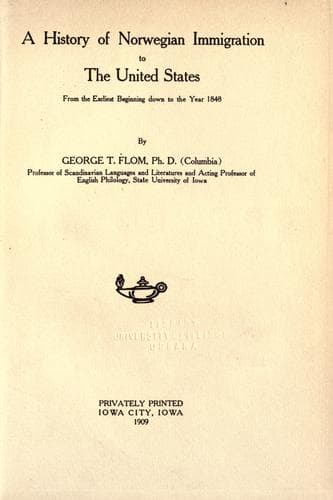
A History of Norwegian Immigration to the United States: From the Earliest Beginning down to the Year 1848 — John Shaqi
A History of Norwegian Immigration to the United States: From the Earliest Beginning down to the Year 1848Flom, George T. (George Tobias)
History
A History of Norwegian Immigration to the United States: From the Earliest Beginning down to the Year 1848
Flom, George T. (George Tobias)
Norwegians -- United States
[2] Compare Björnson's account of the temperature at Kvikne in his
autobiographical sketch, _Blakken_.
[3] The statistical and much of the other matter in this chapter
has been taken from _Norway, Official Publication for the
Paris Exhibition_, 1900, published at Christiania. But I am
also indebted to the stately publication by Norwegian authors
and artists entitled _Norge i det nittende Aarhundrede_, 2
volumes, large folio, 436 and 468 pages. Christiania, 1900. The
scholars who published this are W. C. Brögger, B. Getz, A. N.
Kjær, Moltke Moe, Bredo Morgenstjerne, Gerhard Munthe, Frithjof
Nansen, Eilif Peterssen, Nordahl Rolfsen, J. E. Sars, Gustav
Storm and E. Werenskjold. The editor in chief for the texts is
Nordahl Rolfsen, for the illustrations E. Werenskjold. There
is a large staff of collaborators, each article is prepared by
a specialist; the whole is a rare piece of book-making. The
printers are Alb. Cammermeyers Forlag, Christiania. I wish
to mention also especially here Christensen's _Det nittende
Aarhundredes Kulturkamp i Norge_, Christiania, 1905.
The population of Norway[4] is very unevenly distributed, the north
being rather thinly settled. The area of Norway is 124,495 square
miles, or somewhat more than that of Wisconsin and Illinois together.
About four per cent of this, however, is covered by lakes, and the
average number of inhabitants to the square mile is only seventeen. The
corresponding figures of inhabitants to the square mile for Sweden is
twenty-eight; for Denmark, however, it is one hundred and forty-eight,
and for all Europe, it is ninety-eight. The density of population is
greatest in Larvik and Jarlsberg on the south (barring the cities of
Christiania and Bergen). In these provinces there are one hundred and
sixteen inhabitants to the square mile. In Hedemarken the number falls
to twelve. The western fjord districts, those of Trondhjem Fjord, the
Sogne Fjord and the Hardanger Fjord are thickly populated.
[4] It was 1,490,950 in 1855, 2,350,000 in 1908.
Norway is a land of fjords and lakes, of mountains and glacier
expanses. Less than one-fourth of the country is capable of
cultivation, and eighty per cent of this is forest land. This leaves
less than five per cent under actual cultivation. We may compare again
with Denmark, where seventy-six per cent of the land is cultivated,
while in all Europe the ratio is forty per cent.
Norway's climate is noted for its healthfulness,[5] and its inhabitants
attain a higher degree of longevity than those of most other European
countries. Nearly seven per cent of its people reach the age of sixty
to seventy, while one per cent attain to the age of from ninety to one
hundred years. That is, reckoned as a whole, about twelve per cent
attain to the age of sixty years or more. This is considerable in excess
of that of nearly all other European countries.
Public-domain text, read in full here on John Shaqi.
Reviews
Reviews
No reviews yet
Be the first to share your thoughts on this work.
Join the Discussion
Join the discussion
Sign in to leave a comment or review.
Sign InorCreate an account