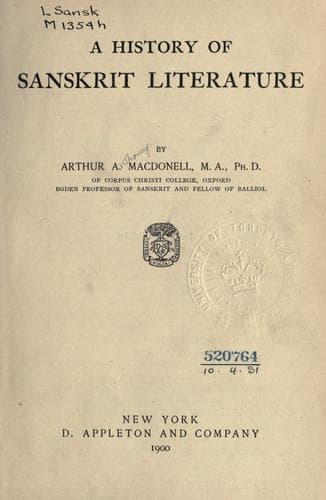
A History of Sanskrit LiteratureMacdonell, Arthur Anthony
History
A History of Sanskrit Literature
Macdonell, Arthur Anthony
Sanskrit literature -- History and criticism
To the school of the Tandins belongs the Panchavimça ("twenty-five
fold"), also called Tandya or Praudha, Brahmana, which, as the first
name implies, consists of twenty-five books. It is concerned with
the Soma sacrifices in general, ranging from the minor offerings to
those which lasted a hundred days, or even several years. Besides
many legends, it contains a minute description of sacrifices performed
on the Sarasvati and Drishadvati. Though Kurukshetra is known to it,
other geographical data which it contains point to the home of this
Brahmana having lain farther east. Noteworthy among its contents are
the so-called Vratya-Stomas, which are sacrifices meant to enable
Aryan but non-Brahmanical Indians to enter the Brahmanical order. A
point of interest in this Brahmana is the bitter hostility which
it displays towards the school of the Kaushitakins. The Shadvimça
Brahmana, though nominally an independent work, is in reality a
supplement to the Panchavimça, of which, as its name implies, it
forms the twenty-sixth book. The last of its six chapters is called
the Adbhuta Brahmana, which is intended to obviate the evil effects
of various extraordinary events or portents. Among such phenomena
are mentioned images of the gods when they laugh, cry, sing, dance,
perspire, crack, and so forth.
The other Brahmana of this school, the Chhandogya Brahmana, is only
to a slight extent a ritual text-book. It does not deal with the
Soma sacrifice at all, but only with ceremonies relating to birth
and marriage or prayers addressed to divine beings. These are the
contents of only the first two "lessons" of this Brahmana of the Sama
theologians. The remaining eight lessons constitute the Chhandogya
Upanishad.
There are four other short works which, though bearing the name, are
not really Brahmanas. These are the Samavidhana Brahmana, a treatise on
the employment of chants for all kinds of superstitious purposes; the
Devatadhyaya Brahmana, containing some statements about the deities
of the various chants of the Samaveda; the Vamça Brahmana, which
furnishes a genealogy of the teachers of the Samaveda; and, finally,
the Samhitopanishad, which, like the third book of the Aitareya
Aranyaka, treats of the way in which the Veda should be recited.
The Brahmanas of the Samaveda are distinguished by the exaggerated and
fantastic character of their mystical speculations. A prominent feature
in them is the constant identification of various kinds of Samans
or chants with all kinds of terrestrial and celestial objects. At
the same time they contain much matter that is interesting from a
historical point of view.
Public-domain text, read in full here on John Shaqi.
Reviews
Reviews
No reviews yet
Be the first to share your thoughts on this work.
Elsewhere in the archive
Join the Discussion
Join the discussion
Sign in to leave a comment or review.
Sign InorCreate an account