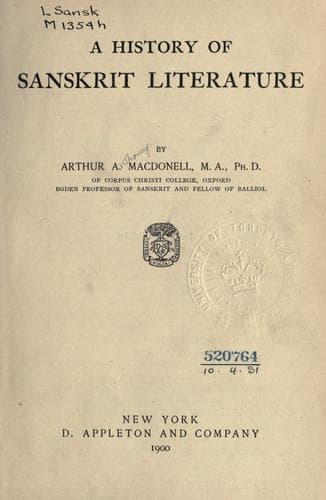
A History of Sanskrit LiteratureMacdonell, Arthur Anthony
History
A History of Sanskrit Literature
Macdonell, Arthur Anthony
Sanskrit literature -- History and criticism
The essential theme of the Upanishads is the nature of the
world-soul. Their conception of it represents the final stage in
the development from the world-man, Purusha, of the Rigveda to
the world-soul, Atman; from the personal creator, Prajapati, to
the impersonal source of all being, Brahma. Atman in the Rigveda
means no more than "breath"; wind, for instance, being spoken of
as the atman of Varuna. In the Brahmanas it came to mean "soul" or
"self." In one of their speculations the pranas or "vital airs,"
which are supposed to be based on the atman, are identified with the
gods, and so an atman comes to be attributed to the universe. In one
of the later books of the Çatapatha Brahmana (X. vi. 3) this atman,
which has already arrived at a high degree of abstraction, is said to
"pervade this universe." Brahma (neuter) in the Rigveda signified
nothing more than "prayer" or "devotion." But even in the oldest
Brahmanas it has come to have the sense of "universal holiness,"
as manifested in prayer, priest, and sacrifice. In the Upanishads
it is the holy principle which animates nature. Having a long
subsequent history, this word is a very epitome of the evolution of
religious thought in India. These two conceptions, Atman and Brahma,
are commonly treated as synonymous in the Upanishads. But, strictly
speaking, Brahma, the older term, represents the cosmical principle
which pervades the universe, Atman the psychical principle manifested
in man; and the latter, as the known, is used to explain the former
as the unknown. The Atman under the name of the Eternal (aksharam)
is thus described in the Brihadaranyaka Upanishad (III. viii. 8, 11):--
"It is not large, and not minute; not short, not long; without
blood, without fat; without shadow, without darkness; without wind,
without ether; not adhesive, not tangible; without smell, without
taste; without eyes, ears, voice, or mind; without heat, breath, or
mouth; without personal or family name; unaging, undying, without
fear, immortal, dustless, not uncovered or covered; with nothing
before, nothing behind, nothing within. It consumes no one and
is consumed by no one. It is the unseen seer, the unheard hearer,
the unthought thinker, the unknown knower. There is no other seer,
no other hearer, no other thinker, no other knower. That is the
Eternal in which space (akaça) is woven and which is interwoven
with it."
Here, for the first time in the history of human thought, we find
the Absolute grasped and proclaimed.
A poetical account of the nature of the Atman is given by the Kathaka
Upanishad in the following stanzas:--
That whence the sun's orb rises up,
And that in which it sinks again:
In it the gods are all contained,
Beyond it none can ever pass (iv. 9).
Public-domain text, read in full here on John Shaqi.
Reviews
Reviews
No reviews yet
Be the first to share your thoughts on this work.
Elsewhere in the archive
Join the Discussion
Join the discussion
Sign in to leave a comment or review.
Sign InorCreate an account