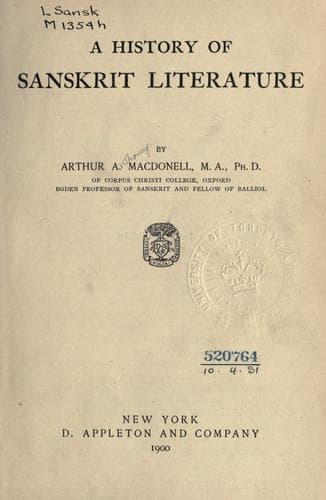
A History of Sanskrit LiteratureMacdonell, Arthur Anthony
History
A History of Sanskrit Literature
Macdonell, Arthur Anthony
Sanskrit literature -- History and criticism
Its form can never be to sight apparent,
Not any one may with his eye behold it:
By heart and mind and soul alone they grasp it,
And those who know it thus become immortal (vi. 9).
Since not by speech and not by thought,
Not by the eye can it be reached:
How else may it be understood
But only when one says "it is"? (vi. 12).
The place of the more personal Prajapati is taken in the Upanishads by
the Atman as a creative power. Thus the Brihadaranyaka (I. iv.) relates
that in the beginning the Atman or the Brahma was this universe. It
was afraid in its loneliness and felt no pleasure. Desiring a second
being, it became man and woman, whence the human race was produced. It
then proceeded to produce male and female animals in a similar way;
finally creating water, fire, the gods, and so forth. The author then
proceeds in a more exalted strain:--
"It (the Atman) is here all-pervading down to the tips of the
nails. One does not see it any more than a razor hidden in its case
or fire in its receptacle. For it does not appear as a whole. When
it breathes, it is called breath; when it speaks, voice; when it
hears, ear; when it thinks, mind. These are merely the names of
its activities. He who worships the one or the other of these,
has not (correct) knowledge.... One should worship it as the
Self. For in it all these (breath, etc.) become one."
In one of the later Upanishads, the Çvetaçvatara (iv. 10), the notion,
so prominent in the later Vedanta system, that the material world is
an illusion (maya), is first met with. The world is here explained
as an illusion produced by Brahma as a conjuror (mayin). This notion
is, however, inherent even in the oldest Upanishads. It is virtually
identical with the teaching of Plato that the things of experience
are only the shadow of the real things, and with the teaching of Kant,
that they are only phenomena of the thing in itself.
The great fundamental doctrine of the Upanishads is the identity of the
individual atman with the world Atman. It is most forcibly expressed in
a frequently repeated sentence of the Chhandogya Upanishad (vi. 8-16):
"This whole world consists of it: that is the Real, that is the Soul,
that art thou, O Çvetaketu." In that famous formula, "That art thou"
(tat tvam asi), all the teachings of the Upanishads are summed
up. The Brihadaranyaka (I. iv. 6) expresses the same doctrine thus:
"Whoever knows this, 'I am brahma' (aham brahma asmi), becomes the
All. Even the gods are not able to prevent him from becoming it. For
he becomes their Self (atman)."
This identity was already recognised in the Çatapatha Brahmana
(X. vi. 3): "Even as the smallest granule of millet, so is this
golden Purusha in the heart.... That self of the spirit is my self:
on passing from hence I shall obtain that Self."
Public-domain text, read in full here on John Shaqi.
Reviews
Reviews
No reviews yet
Be the first to share your thoughts on this work.
Elsewhere in the archive
Join the Discussion
Join the discussion
Sign in to leave a comment or review.
Sign InorCreate an account