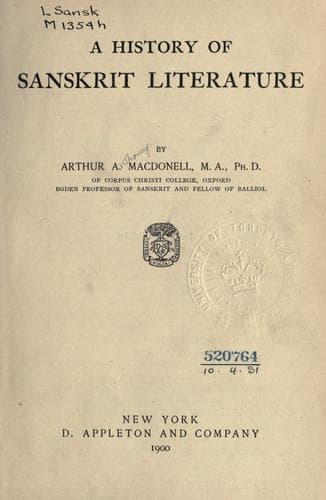
A History of Sanskrit LiteratureMacdonell, Arthur Anthony
History
A History of Sanskrit Literature
Macdonell, Arthur Anthony
Sanskrit literature -- History and criticism
We find everywhere in these treatises a restless striving to grasp
the true nature of the pantheistic Self, now through one metaphor,
now through another. Thus (Brih. Up. II. iv.) the wise Yajnavalkya,
about to renounce the world and retire to the forest, replies to the
question of his wife, Maitreyi, with the words: "As a lump of salt
thrown into the water would dissolve and could not be taken out again,
while the water, wherever tasted, would be salt, so is this great
being endless, unlimited, simply compacted of cognition. Arising
out of these elements, it disappears again in them. After death
there is no consciousness;" for, as he further explains, when the
duality on which consciousness is based disappears, consciousness
must necessarily cease.
In another passage of the same Upanishad (II. i. 20) we read: "Just
as the spider goes out of itself by means of its thread, as tiny
sparks leap out of the fire, so from the Atman issue all vital airs,
all worlds, all gods, all beings."
Here, again, is a stanza from the Mundaka (III. ii. 8):--
As rivers flow and disappear at last
In ocean's waters, name and form renouncing,
So, too, the sage, released from name and form,
Is merged in the divine and highest spirit.
In a passage of the Brihadaranyaka (III. vii.) Yajnavalkya describes
the Atman as the "inner guide" (antaryamin): "Who is in all beings,
different from all beings, who guides all beings within, that is thy
Self, the inward guide, immortal."
The same Upanishad contains an interesting conversation, in which King
Ajataçatru of Kaçi (Benares) instructs the Brahman, Balaki Gargya,
that Brahma is not the spirit (purusha) which is in sun, moon, wind,
and other natural phenomena, or even in the (waking) soul (atman),
but is either the dreaming soul, which is creative, assuming any form
at pleasure, or, in the highest stage, the soul in dreamless sleep,
for here all phenomena have disappeared. This is the first and the
last condition of Brahma, in which no world exists, all material
existence being only the phantasms of the dreaming world-soul.
Of somewhat similar purport is a passage of the Chhandogya
(viii. 7-12), where Prajapati is represented as teaching the nature
of the Atman in three stages. The soul in the body as reflected in
a mirror or water is first identified with Brahma, then the dreaming
soul, and, lastly, the soul in dreamless sleep.
How generally accepted the pantheistic theory must have become by
the time the disputations at the court of King Janaka took place, is
indicated by the form in which questions are put. Thus two different
sages in the Brihadaranyaka (iii. 4, 5) successively ask Yajnavalkya
in the same words: "Explain to us the Brahma which is manifest and
not hidden, the Atman that dwells in everything."
Public-domain text, read in full here on John Shaqi.
Reviews
Reviews
No reviews yet
Be the first to share your thoughts on this work.
Elsewhere in the archive
Join the Discussion
Join the discussion
Sign in to leave a comment or review.
Sign InorCreate an account