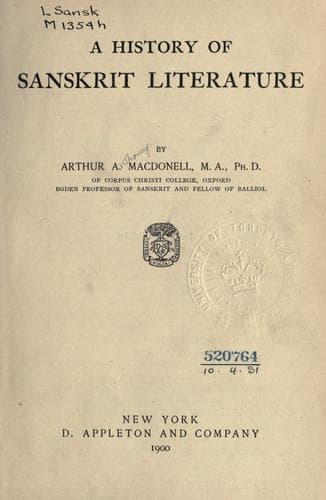
A History of Sanskrit LiteratureMacdonell, Arthur Anthony
History
A History of Sanskrit Literature
Macdonell, Arthur Anthony
Sanskrit literature -- History and criticism
With the doctrine that true knowledge led to supreme bliss by the
absorption of the individual soul in Brahma went hand in hand the
theory of transmigration (samsara). That theory is developed in
the oldest Upanishads; it must have been firmly established by the
time Buddhism arose, for Buddha accepted it without question. Its
earliest form is found in the Çatapatha Brahmana, where the notion
of being born again after death and dying repeatedly is coupled with
that of retribution. Thus it is here said that those who have correct
knowledge and perform a certain sacrifice are born again after death
for immortality, while those who have not such knowledge and do not
perform this sacrifice are reborn again and again, becoming the prey
of Death. The notion here expressed does not go beyond repeated births
and deaths in the next world. It is transformed to the doctrine of
transmigration in the Upanishads by supposing rebirth to take place in
this world. In the Brihadaranyaka we further meet with the beginnings
of the doctrine of karma, or "action," which regulates the new birth,
and makes it depend on a man's own deeds. When the body returns to
the elements, nothing of the individuality is here said to remain
but the karma, according to which a man becomes good or bad. This is,
perhaps, the germ of the Buddhistic doctrine, which, though denying
the existence of soul altogether, allows karma to continue after
death and to determine the next birth.
The most important and detailed account of the theory of transmigration
which we possess from Vedic times is supplied by the Chhandogya
Upanishad. The forest ascetic possessed of knowledge and faith, it is
here said, after death enters the devayana, the "path of the gods,"
which leads to absorption in Brahma, while the householder who has
performed sacrifice and good works goes by the pitriyana or "path of
the Fathers" to the moon, where he remains till the consequences of
his actions are exhausted. He then returns to earth, being first born
again as a plant and afterwards as a man of one of the three highest
castes. Here we have a double retribution, first in the next world,
then by transmigration in this. The former is a survival of the old
Vedic belief about the future life. The wicked are born again as
outcasts (chandalas), dogs or swine.
The account of the Brihadaranyaka (VI. ii. 15-16) is similar. Those
who have true knowledge and faith pass through the world of the gods
and the sun to the world of Brahma, whence there is no return. Those
who practise sacrifice and good works pass through the world of the
Fathers to the moon, whence they return to earth, being born again
as men. Others become birds, beasts, and reptiles.
Public-domain text, read in full here on John Shaqi.
Reviews
Reviews
No reviews yet
Be the first to share your thoughts on this work.
Elsewhere in the archive
Join the Discussion
Join the discussion
Sign in to leave a comment or review.
Sign InorCreate an account