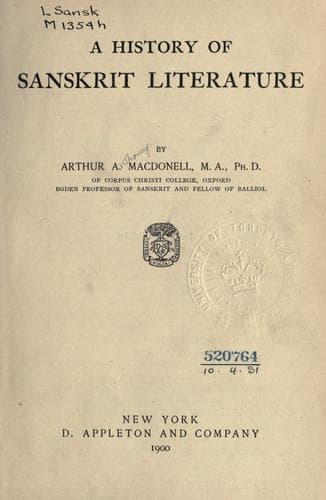
A History of Sanskrit LiteratureMacdonell, Arthur Anthony
History
A History of Sanskrit Literature
Macdonell, Arthur Anthony
Sanskrit literature -- History and criticism
The view of the Kaushitaki Upanishad (i. 2-3) is somewhat
different. Here all who die go to the moon, whence some go by the
"path of the Fathers" to Brahma, while others return to various
forms of earthly existence, ranging from man to worm, according to
the quality of their works and the degree of their knowledge.
The Kathaka, one of the most remarkable and beautiful of the
Upanishads, treats the question of life after death in the form of a
legend. Nachiketas, a young Brahman, visits the realm of Yama, who
offers him the choice of three boons. For the third he chooses the
answer to the question, whether man exists after death or no. Death
replies: "Even the gods have doubted about this; it is a subtle point;
choose another boon." After vain efforts to evade the question by
offering Nachiketas earthly power and riches, Yama at last yields to
his persistence and reveals the secret. Life and death, he explains,
are only different phases of development. True knowledge, which
consists in recognising the identity of the individual soul with the
world soul, raises its possessor beyond the reach of death:--
When every passion vanishes
That nestles in the human heart,
Then man gains immortality,
Then Brahma is obtained by him (vi. 14).
The story of the temptation of Nachiketas to choose the goods of this
world in preference to the highest knowledge is probably the prototype
of the legend of the temptation of Buddha by Mara or Death. Both by
resisting the temptation obtain enlightenment.
Public-domain text, read in full here on John Shaqi.
Reviews
Reviews
No reviews yet
Be the first to share your thoughts on this work.
Elsewhere in the archive
Join the Discussion
Join the discussion
Sign in to leave a comment or review.
Sign InorCreate an account