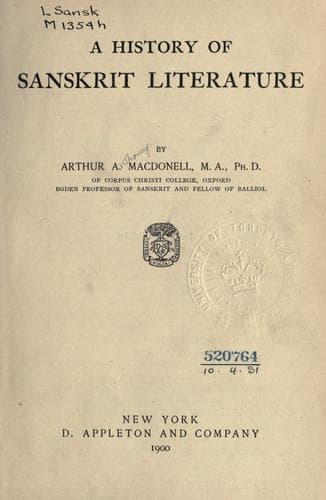
A History of Sanskrit LiteratureMacdonell, Arthur Anthony
History
A History of Sanskrit Literature
Macdonell, Arthur Anthony
Sanskrit literature -- History and criticism
It must not of course be supposed that the Upanishads, either as a
whole or individually, offer a complete and consistent conception
of the world logically developed. They are rather a mixture
of half-poetical, half-philosophical fancies, of dialogues and
disputations dealing tentatively with metaphysical questions. Their
speculations were only later reduced to a system in the Vedanta
philosophy. The earliest of them can hardly be dated later than about
600 B.C., since some important doctrines first met with in them are
presupposed by Buddhism. They may be divided chronologically, on
internal evidence, into four classes. The oldest group, consisting,
in chronological order, of the Brihadaranyaka, Chhandogya, Taittiriya,
Aitareya, Kaushitaki, is written in prose which still suffers from the
awkwardness of the Brahmana style. A transition is formed by the Kena,
which is partly in verse and partly in prose, to a decidedly later
class, the Kathaka, Iça, Çvetaçvatara, Mundaka, Mahanarayana, which are
metrical, and in which the Upanishad doctrine is no longer developing,
but has become fixed. These are more attractive from the literary
point of view. Even those of the older class acquire a peculiar
charm from their liveliness, enthusiasm, and freedom from pedantry,
while their language often rises to the level of eloquence. The third
class, comprising the Praçna, Maitrayaniya, and Mandukya, reverts to
the use of prose, which is, however, of a much less archaic type than
that of the first class, and approaches that of classical Sanskrit
writers. The fourth class consists of the later Atharvan Upanishads,
some of which are composed in prose, others in verse.
The Aitareya, one of the shortest of the Upanishads (extending to
only about four octavo pages), consists of three chapters. The first
represents the world as a creation of the Atman (also called Brahma),
and man as its highest manifestation. It is based on the Purusha hymn
of the Rigveda, but the primeval man is in the Upanishad described as
having been produced by the Atman from the waters which it created. The
Atman is here said to occupy three abodes in man, the senses, mind,
and heart, to which respectively correspond the three conditions of
waking, dreaming, and deep sleep. The second chapter treats of the
threefold birth of the Atman. The end of transmigration is salvation,
which is represented as an immortal existence in heaven. The last
chapter dealing with the nature of the Atman states that "consciousness
(prajna) is Brahma."
Public-domain text, read in full here on John Shaqi.
Reviews
Reviews
No reviews yet
Be the first to share your thoughts on this work.
Elsewhere in the archive
Join the Discussion
Join the discussion
Sign in to leave a comment or review.
Sign InorCreate an account