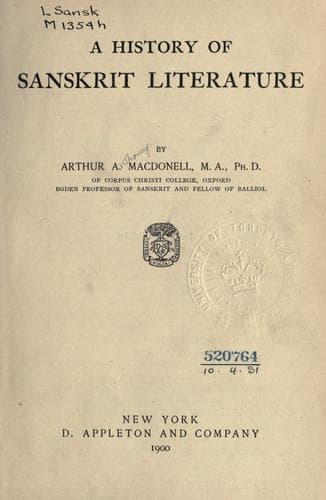
A History of Sanskrit LiteratureMacdonell, Arthur Anthony
History
A History of Sanskrit Literature
Macdonell, Arthur Anthony
Sanskrit literature -- History and criticism
The Kaushitaki Upanishad is a treatise of considerable length divided
into four chapters. The first deals with the two paths traversed by
souls after death in connection with transmigration; the second with
Prana or life as a symbol of the Atman. The last two, while discussing
the doctrine of Brahma, contain a disquisition about the dependence
of the objects of sense on the organs of sense, and of the latter on
unconscious life (prana) and conscious life (prajnatma). Those who
aim at redeeming knowledge are therefore admonished not to seek after
objects or subjective faculties, but only the subject of cognition
and action, which is described with much power as the highest god,
and at the same time as the Atman within us.
The Upanishads of the Samaveda start from the saman or chant, just
as those of the Rigveda from the uktha or hymn recited by the Hotri
priest, in order, by interpreting it allegorically, to arrive at a
knowledge of the Atman or Brahma. The fact that the Upanishads have the
same basis, which is, moreover, largely treated in a similar manner,
leads to the conclusion that the various Vedic schools found a common
body of oral tradition which they shaped into dogmatic texts-books
or Upanishads in their own way.
Thus the Chhandogya, which is equal in importance, and only slightly
inferior in extent, to the Brihadaranyaka, bears clear traces,
like the latter, of being made up of collections of floating
materials. Each of its eight chapters forms an independent whole,
followed by supplementary pieces often but slightly connected with
the main subject-matter.
The first two chapters consist of mystical interpretations of the
saman and its chief part, called Udgitha ("loud song"). A supplement
to the second chapter treats, among other subjects, of the origin of
the syllable om, and of the three stages of religious life, those of
the Brahman pupil, the householder, and the ascetic (to which later
the religious mendicant was added as a fourth). The third chapter in
the main deals with Brahma as the sun of the universe, the natural sun
being its manifestation. The infinite Brahma is further described as
dwelling, whole and undivided, in the heart of man. The way in which
Brahma is to be attained is then described, and the great fundamental
dogma of the identity of Brahma with the Atman (or, as we might say,
of God and Soul) is declared. The chapter concludes with a myth
which forms a connecting link between the cosmogonic conceptions of
the Rigveda and those of the law-book of Manu. The fourth chapter,
containing discussions about wind, breath, and other phenomena
connected with Brahma, also teaches how the soul makes its way to
Brahma after death.
Public-domain text, read in full here on John Shaqi.
Reviews
Reviews
No reviews yet
Be the first to share your thoughts on this work.
Elsewhere in the archive
Join the Discussion
Join the discussion
Sign in to leave a comment or review.
Sign InorCreate an account