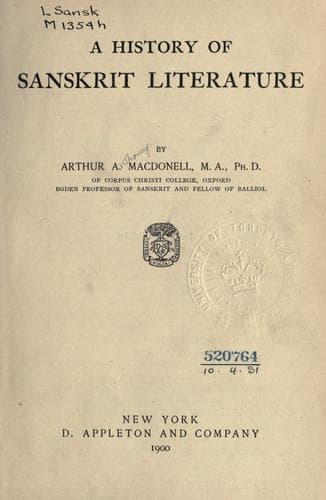
A History of Sanskrit LiteratureMacdonell, Arthur Anthony
History
A History of Sanskrit Literature
Macdonell, Arthur Anthony
Sanskrit literature -- History and criticism
The first half of chapter v. is almost identical with the beginning of
chapter vi. of the Brihadaranyaka. It is chiefly noteworthy for the
theory of transmigration which it contains. The second half of the
chapter is important as the earliest statement of the doctrine that
the manifold world is unreal. The sat by desire produced from itself
the three primary elements, heat, water, food (the later number being
five--ether, air, fire, water, earth). As individual soul (jiva-atman)
it entered into these, which, by certain partial combinations called
"triplication," became various products (vikara) or phenomena. But
the latter are a mere name. Sat is the only reality, it is the Atman:
"Thou art that." Chapter vii. enumerates sixteen forms in which Brahma
may be adored, rising by gradation from naman, "name," to bhuman,
"infinity," which is the all-in-all and the Atman within us. The first
half of the last chapter discusses the Atman in the heart and the
universe, as well as how to attain it. The concluding portion of the
chapter distinguishes the false from the true Atman, illustrated by the
three stages in which it appears--in the material body, in dreaming,
and in sound sleep. In the latter stage we have the true Atman,
in which the distinction between subject and object has disappeared.
To the Samaveda also belongs a very short treatise which was long
called the Talavakara Upanishad, from the school to which it was
attached, but later, when it became separated from that school,
received the name of Kena, from its initial word. It consists of two
distinct parts. The second, composed in prose and much older, describes
the relation of the Vedic gods to Brahma, representing them as deriving
their power from and entirely dependent on the latter. The first part,
which is metrical and belongs to the period of fully developed Vedanta
doctrine, distinguishes from the qualified Brahma, which is an object
of worship, the unqualified Brahma, which is unknowable:--
To it no eye can penetrate,
Nor speech nor thought can ever reach:
It rests unknown; we cannot see
How any one may teach it us.
Public-domain text, read in full here on John Shaqi.
Reviews
Reviews
No reviews yet
Be the first to share your thoughts on this work.
Elsewhere in the archive
Join the Discussion
Join the discussion
Sign in to leave a comment or review.
Sign InorCreate an account