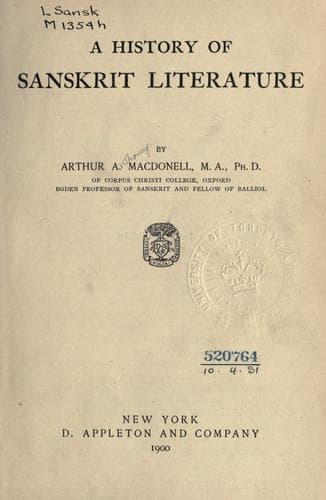
A History of Sanskrit LiteratureMacdonell, Arthur Anthony
History
A History of Sanskrit Literature
Macdonell, Arthur Anthony
Sanskrit literature -- History and criticism
The various Upanishads of the Black Yajurveda all bear the stamp
of lateness. The Maitrayana is a prose work of considerable extent,
in which occasional stanzas are interspersed. It consists of seven
chapters, the seventh and the concluding eight sections of the sixth
forming a supplement. The fact that it retains the orthographical and
euphonic peculiarities of the Maitrayana school, gives this Upanishad
an archaic appearance. But its many quotations from other Upanishads,
the occurrence of several late words, the developed Sankhya doctrine
presupposed by it, distinct references to anti-Vedic heretical schools,
all combine to render the late character of this work undoubted. It is,
in fact, a summing up of the old Upanishad doctrines with an admixture
of ideas derived from the Sankhya system and from Buddhism. The main
body of the treatise expounds the nature of the Atman, communicated
to King Brihadratha of the race of Ikshvaku (probably identical with
the king of that name mentioned in the Ramayana), who declaims at some
length on the misery and transitoriness of earthly existence. Though
pessimism is not unknown to the old Upanishads, it is much more
pronounced here, doubtless in consequence of Sankhya and Buddhistic
influence.
The subject is treated in the form of three questions. The answer
to the first, how the Atman enters the body, is that Prajapati
enters in the form of the five vital airs in order to animate the
lifeless bodies created by him. The second question is, How does
the supreme soul become the individual soul (bhutatman)? This is
answered rather in accordance with the Sankhya than the Vedanta
doctrine. Overcome by the three qualities of matter (prakriti),
the Atman, forgetting its real nature, becomes involved in
self-consciousness and transmigration. The third question is, How
is deliverance from this state of misery possible? This is answered
in conformity with neither Vedanta nor Sankhya doctrine, but in a
reactionary spirit. Only those who observe the old requirements of
Brahmanism, the rules of caste and the religious orders (açramas),
are declared capable of attaining salvation by knowledge, penance,
and meditation on Brahma. The chief gods, that is to say, the triad of
the Brahmana period, Fire, Wind, Sun, the three abstractions, Time,
Breath, Food, and the three popular gods, Brahma, Rudra (i.e. Çiva),
and Vishnu are explained as manifestations of Brahma.
Public-domain text, read in full here on John Shaqi.
Reviews
Reviews
No reviews yet
Be the first to share your thoughts on this work.
Elsewhere in the archive
Join the Discussion
Join the discussion
Sign in to leave a comment or review.
Sign InorCreate an account