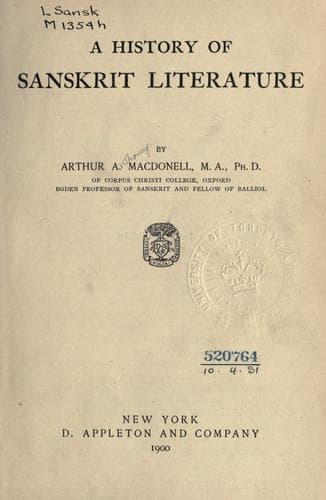
A History of Sanskrit LiteratureMacdonell, Arthur Anthony
History
A History of Sanskrit Literature
Macdonell, Arthur Anthony
Sanskrit literature -- History and criticism
The remainder of this Upanishad is supplementary, but contains several
passages of considerable interest. We have here a cosmogonic myth,
like those of the Brahmanas, in which the three qualities of matter,
Tamas, Rajas, Sattva, are connected with Rudra, Brahma, and Vishnu, and
which is in other respects very remarkable as a connecting link between
the philosophy of the Rigveda and the later Sankhya system. The sun
is further represented as the external, and prana (breath) as the
internal, symbol of the Atman, their worship being recommended by
means of the sacred syllable om, the three "utterances" (vyahritis)
bhur, bhuvah, svar, and the famous Savitri stanza. As a means of
attaining Brahma we find a recommendation of Yoga or the ascetic
practices leading to a state of mental concentration and bordering
on trance. The information we here receive of these practices is
still undeveloped compared with the later system. In addition to
the three conditions of Brahma, waking, dreaming, and deep sleep,
mention is made of a fourth (turiya) and highest stage. The Upanishad
concludes with the declaration that the Atman entered the world of
duality because it wished to taste both truth and illusion.
Older than the Maitrayana, which borrows from them, are two
other Upanishads of the Black Yajurveda, the Kathaka and the
Çvetaçvatara. The former contains some 120 and the latter some 110
stanzas.
The Kathaka deals with the legend of Nachiketas, which is told in
the Kathaka portion of the Taittiriya Brahmana, and a knowledge of
which it presupposes. This is indicated by the fact that it begins
with the same words as the Brahmana story. The treatise appears to
have consisted originally of the first only of its two chapters. For
the second, with its more developed notions about Yoga and its much
more pronounced view as to the unreality of phenomena, looks like
a later addition. The first contains an introductory narrative, an
account of the Atman, of its embodiment and final return by means of
Yoga. The second chapter, though less well arranged, on the whole
corresponds in matter with the first. Its fourth section, while
discussing the nature of the Atman, identifies both soul (purusha)
and matter (prakriti) with it. The fifth section deals with the
manifestation of the Atman in the world, and especially in man. The
way in which it at the same time remains outside them in its full
integrity and is not affected by the suffering of living beings, is
strikingly illustrated by the analogy of both light and air, which
pervade space and yet embrace every object, and of the sun, the eye
of the universe, which remains free from the blemishes of all other
eyes outside of it. In the last section Yoga is taught to be the means
of attaining the highest goal. The gradation of mental faculties here
described is of great interest for the history of the Sankhya and Yoga
system. An unconscious contradiction runs through this discussion,
Public-domain text, read in full here on John Shaqi.
Reviews
Reviews
No reviews yet
Be the first to share your thoughts on this work.
Elsewhere in the archive
Join the Discussion
Join the discussion
Sign in to leave a comment or review.
Sign InorCreate an account