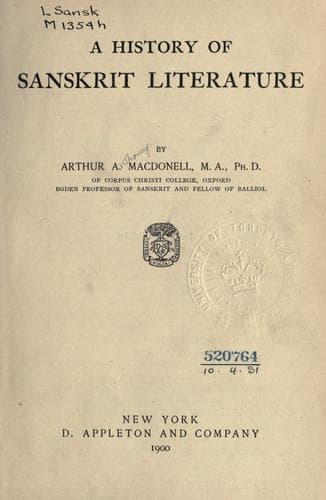
A History of Sanskrit LiteratureMacdonell, Arthur Anthony
History
A History of Sanskrit Literature
Macdonell, Arthur Anthony
Sanskrit literature -- History and criticism
inasmuch as though the Atman is regarded as the all-in-all, a sharp
contrast is drawn between soul and matter. It is the contradiction
between the later Vedanta and the Sankhya-Yoga systems of philosophy.
According to its own statement, the Çvetaçvatara Upanishad derives its
name from an individual author, and the tradition which attributes it
to one of the schools of the Black Yajurveda hardly seems to have a
sufficient foundation. Its confused arrangement, the irregularities
and arbitrary changes of its metres, the number of interpolated
quotations which it contains, make the assumption likely that the
work in its present form is not the work of a single author. In its
present form it is certainly later than the Kathaka, since it contains
several passages which must be referred to that work, besides many
stanzas borrowed from it with or without variation. Its lateness is
further indicated by the developed theory of Yoga which it contains,
besides the more or less definite form in which it exhibits various
Vedanta doctrines either unknown to or only foreshadowed in the
earlier Upanishads. Among these may be mentioned the destruction of
the world by Brahma at the end of a cosmic age (kalpa), as well as
its periodic renewal out of Brahma, and especially the explanation of
the world as an illusion (maya) produced by Brahma. At the same time
the author shows a strange predilection for the personified forms of
Brahma as Savitri, Içana, or Rudra. Though Çiva has not yet become
the name of Rudra, its frequent use as an adjective connected with
the latter shows that it is in course of becoming fixed as the proper
name of the highest god. In this Upanishad we meet with a number of
the terms and fundamental notions of the Sankhya, though the point
of view is thoroughly Vedantist; matter (prakriti), for instance,
being represented as an illusion produced by Brahma.
Public-domain text, read in full here on John Shaqi.
Reviews
Reviews
No reviews yet
Be the first to share your thoughts on this work.
Elsewhere in the archive
Join the Discussion
Join the discussion
Sign in to leave a comment or review.
Sign InorCreate an account