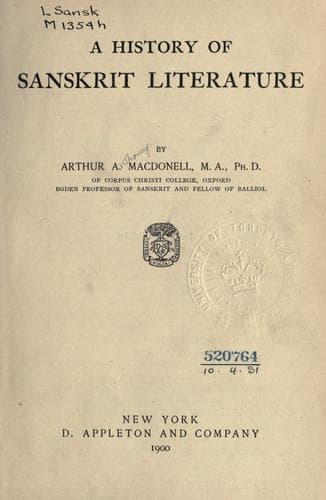
A History of Sanskrit LiteratureMacdonell, Arthur Anthony
History
A History of Sanskrit Literature
Macdonell, Arthur Anthony
Sanskrit literature -- History and criticism
To the White Yajurveda is attached the longest, and, beside the
Chhandogya, the most important of the Upanishads. It bears even
clearer traces than that work of being a conglomerate of what must
originally have been separate treatises. It is divided into three
parts, each containing two chapters. The last part is designated, even
in the tradition of the commentaries, as a supplement (Khila-kanda),
a statement fully borne out by the contents. That the first and second
parts were also originally independent of each other is sufficiently
proved by both containing the legend of Yajnavalkya and his two
wives in almost identical words throughout. To each of these parts
(as well as to Book x. of the Çatapatha Brahmana) a successive list
(vamça) of teachers is attached. A comparison of these lists seems
to justify the conclusion that the first part (called Madhukanda)
and the second (Yajnavalkya-kanda) existed during nine generations
as independent Upanishads within the school of the White Yajurveda,
and were then combined by a teacher named Agniveçya; the third part,
which consists of all kinds of supplementary matter, being subsequently
added. These lists further make the conclusion probable that the
leading teachers of the ritual tradition (Brahmanas) were different
from those of the philosophical tradition (Upanishads).
Beginning with an allegorical interpretation of the most important
sacrifice, the Açvamedha (horse-sacrifice), as the universe, the first
chapter proceeds to deal with prana (breath) as a symbol of soul,
and then with the creation of the world out of the Atman or Brahma,
insisting on the dependence of all existence on the Supreme Soul,
which appears in every individual as his self. The polemical attitude
adopted against the worship of the gods is characteristic, showing that
the passage belongs to an early period, in which the doctrine of the
superiority of the Atman to the gods was still asserting itself. The
next chapter deals with the nature of the Atman and its manifestations,
purusha and prana.
The second part of the Upanishad consists of four philosophical
discussions, in which Yajnavalkya is the chief speaker. The
first (iii. 1-9) is a great disputation, in which the sage proves
his superiority to nine successive interlocutors. One of the most
interesting conclusions here arrived at is that Brahma is theoretically
unknowable, but can be comprehended practically. The second discourse
is a dialogue between King Janaka and Yajnavalkya, in which the latter
shows the untenableness of six definitions set up by other teachers as
to the nature of Brahma; for instance, that it is identical with Breath
or Mind. He finally declares that the Atman can only be described
negatively, being intangible, indestructible, independent, immovable.
Public-domain text, read in full here on John Shaqi.
Reviews
Reviews
No reviews yet
Be the first to share your thoughts on this work.
Elsewhere in the archive
Join the Discussion
Join the discussion
Sign in to leave a comment or review.
Sign InorCreate an account