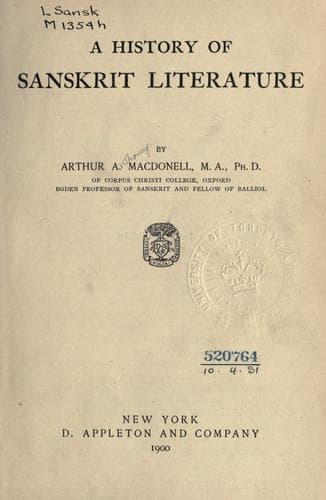
A History of Sanskrit LiteratureMacdonell, Arthur Anthony
History
A History of Sanskrit Literature
Macdonell, Arthur Anthony
Sanskrit literature -- History and criticism
The third discourse (iv. 3-4) is another dialogue between Janaka and
Yajnavalkya. It presents a picture of the soul in the conditions of
waking, dreaming, deep sleep, dying, transmigration, and salvation. For
wealth of illustration, fervour of conviction, beauty and elevation
of thought, this piece is unequalled in the Upanishads or any other
work of Indian literature. Its literary effect is heightened by the
numerous stanzas with which it is interspersed. These are, however,
doubtless later additions. The dreaming soul is thus described:--
Leaving its lower nest in breath's protection,
And upward from that nest, immortal, soaring,
Where'er it lists it roves about immortal,
The golden-pinioned only swan of spirit (IV. iii. 13).
It roves in dream condition up and downward,
Divinely many shapes and forms assuming (ib. 14).
Then follows an account of the dreamless state of the soul:--
As a falcon or an eagle, having flown about in the air, exhausted
folds together its wings and prepares to alight, so the spirit
hastes to that condition in which, asleep, it feels no desire
and sees no dream (19).
This is its essential form, in which it rises above desire,
is free from evil and without fear. For as one embraced by a
beloved woman wots not of anything without or within, so also
the soul embraced by the cognitional Self wots not of anything
without or within (21).
With regard to the souls of those who are not saved, the view of the
writer appears to be that after death they enter a new body immediately
and without any intervening retribution in the other world, in exact
accordance with their intellectual and moral quality.
As a caterpillar, when it has reached the point of a leaf, makes a
new beginning and draws itself across, so the soul, after casting
off the body and letting go ignorance, makes a new beginning and
draws itself across (IV. iv. 3).
As a goldsmith takes the material of an image and hammers out
of it another newer and more beautiful form, so also the soul
after casting off the body and letting go ignorance, creates for
itself another newer and more beautiful form, either that of the
Fathers or the Gandharvas or the Gods, or Prajapati or Brahma,
or other beings (IV. iv. 4).
But the vital airs of him who is saved, who knows himself to be
identical with Brahma, do not depart, for he is absorbed in Brahma
and is Brahma.
As a serpent's skin, dead and cast off, lies upon an ant-hill,
so his body then lies; but that which is bodiless and immortal,
the life, is pure Brahma, is pure light (IV. iv. 7).
The fourth discourse is a dialogue between Yajnavalkya and his wife
Maitreyi, before the former, about to renounce the world, retires
to the solitude of the forest. There are several indications that
it is a secondary recension of the same conversation occurring in a
previous chapter (II. iv.).
Public-domain text, read in full here on John Shaqi.
Reviews
Reviews
No reviews yet
Be the first to share your thoughts on this work.
Elsewhere in the archive
Join the Discussion
Join the discussion
Sign in to leave a comment or review.
Sign InorCreate an account