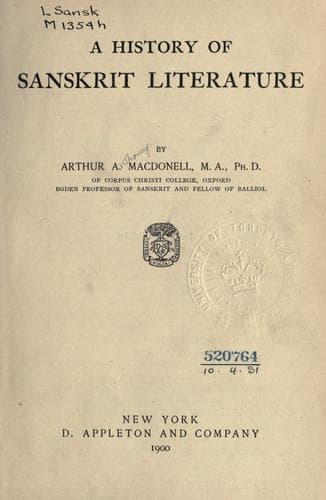
A History of Sanskrit LiteratureMacdonell, Arthur Anthony
History
A History of Sanskrit Literature
Macdonell, Arthur Anthony
Sanskrit literature -- History and criticism
The first chapter of the third or supplementary part consists of
fifteen sections, which are often quite short, are mostly unconnected
in matter, and appear to be of very different age. The second chapter,
however, forms a long and important treatise (identical with that
found in the Chhandogya) on the doctrine of transmigration. The views
here expressed are so much at variance with those of Yajnavalkya
that this text must have originated in another Vedic school, and
have been loosely attached to this Upanishad owing to the peculiar
importance of its contents. The preceding and following section,
which are connected with it, and are also found in the Chhandogya,
must have been added at the same time.
Not only is the longest Upanishad attached to the White Yajurveda,
but also one of the very shortest, consisting of only eighteen
stanzas. This is the Iça, which is so called from its initial
word. Though forming the last chapter of the Vajasaneyi Samhita, it
belongs to a rather late period. It is about contemporaneous with the
latest parts of the Brihadaranyaka, is more developed in many points
than the Kathaka, but seems to be older than the Çvetaçvatara. Its
leading motive is to contrast him who knows himself to be the same as
the Atman with him who does not possess true knowledge. It affords
an excellent survey of the fundamental doctrines of the Vedanta
philosophy.
A large and indefinite number of Upanishads is attributed to
the Atharva-veda, but the most authoritative list recognises
twenty-seven altogether. They are for the most part of very late
origin, being post-Vedic, and, all but three, contemporaneous with
the Puranas. One of them is actually a Muhammadan treatise entitled
the Alla Upanishad! The older Upanishads which belong to the first
three Vedas were, with a few exceptions like the Çvetaçvatara, the
dogmatic text-books of actual Vedic schools, and received their
names from those schools, being connected with and supplementary
to the ritual Brahmanas. The Upanishads of the Atharva-veda, on the
other hand, are with few exceptions like the Mandukya and the Jabala,
no longer connected with Vedic schools, but derive their names from
their subject-matter or some other circumstance. They appear for the
most part to represent the views of theosophic, mystic, ascetic, or
sectarian associations, who wished to have an Upanishad of their own
in imitation of the old Vedic schools. They became attached to the
Atharva-veda not from any internal connection, but partly because the
followers of the Atharva-veda desired to become possessed of dogmatic
text-books of their own, and partly because the fourth Veda was not
protected from the intrusion of foreign elements by the watchfulness
of religious guilds like the old Vedic schools.
Public-domain text, read in full here on John Shaqi.
Reviews
Reviews
No reviews yet
Be the first to share your thoughts on this work.
Elsewhere in the archive
Join the Discussion
Join the discussion
Sign in to leave a comment or review.
Sign InorCreate an account