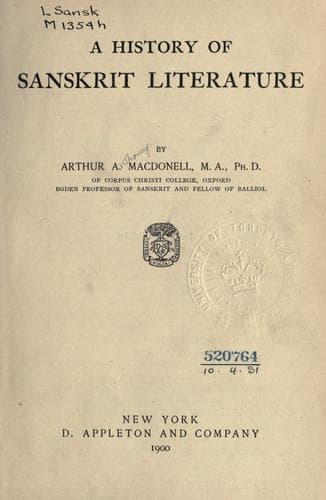
A History of Sanskrit LiteratureMacdonell, Arthur Anthony
History
A History of Sanskrit Literature
Macdonell, Arthur Anthony
Sanskrit literature -- History and criticism
The fundamental doctrine common to all the Upanishads of the
Atharva-veda is developed by most of them in various special
directions. They may accordingly be divided into four categories
which run chronologically parallel with one another, each containing
relatively old and late productions. The first group, as directly
investigating the nature of the Atman, has a scope similar to that of
the Upanishads of the other Vedas, and goes no further than the latter
in developing its main thesis. The next group, taking the fundamental
doctrine for granted, treats of absorption in the Atman through
ascetic meditation (yoga) based on the component parts of the sacred
syllable om. These Upanishads are almost without exception composed in
verse and are quite short, consisting on the average of about twenty
stanzas. In the third category the life of the religious mendicant
(sannyasin), as a practical consequence of the Upanishad doctrine,
is recommended and described. These Upanishads, too, are short, but
are written in prose, though with an admixture of verse. The last
group is sectarian in character, interpreting the popular gods Çiva
(under various names, such as Içana, Maheçvara, Mahadeva) and Vishnu
(as Narayana and Nrisimha or "Man-lion") as personifications of the
Atman. The different Avatars of Vishnu are here regarded as human
manifestations of the Atman.
The oldest and most important of these Atharvan Upanishads, as
representing the Vedanta doctrine most faithfully, are the Mundaka,
the Praçna, and to a less degree the Mandukya. The first two come
nearest to the Upanishads of the older Vedas, and are much quoted by
Badarayana and Çankara, the great authorities of the later Vedanta
philosophy. They are the only original and legitimate Upanishads of the
Atharva. The Mundaka derives its name from being the Upanishad of the
tonsured (munda), an association of ascetics who shaved their heads,
as the Buddhist monks did later. It is one of the most popular of the
Upanishads, not owing to the originality of its contents, which are
for the most part derived from older texts, but owing to the purity
with which it reproduces the old Vedanta doctrine, and the beauty
of the stanzas in which it is composed. It presupposes, above all,
the Chhandogya Upanishad, and in all probability the Brihadaranyaka,
the Taittiriya, and the Kathaka. Having several important passages
in common with the Çvetaçvatara and the Brihannarayana of the Black
Yajurveda, it probably belongs to the same epoch, coming between the
two in order of time. It consists of three parts, which, speaking
generally, deal respectively with the preparations for the knowledge
of Brahma, the doctrine of Brahma, and the way to Brahma.
Public-domain text, read in full here on John Shaqi.
Reviews
Reviews
No reviews yet
Be the first to share your thoughts on this work.
Elsewhere in the archive
Join the Discussion
Join the discussion
Sign in to leave a comment or review.
Sign InorCreate an account