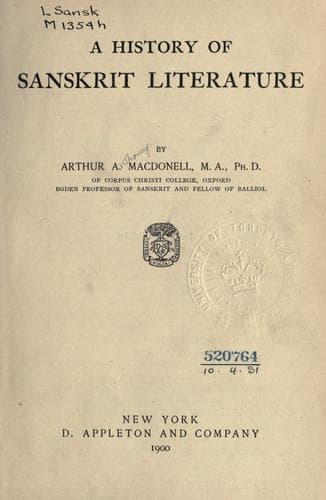
A History of Sanskrit LiteratureMacdonell, Arthur Anthony
History
A History of Sanskrit Literature
Macdonell, Arthur Anthony
Sanskrit literature -- History and criticism
The Praçna Upanishad, written in prose and apparently belonging to
the Pippalada recension of the Atharva-veda, is so called because it
treats, in the form of questions (praçna) addressed by six students
of Brahma to the sage Pippalada, six main points of the Vedanta
doctrine. These questions concern the origin of matter and life
(prana) from Prajapati; the superiority of life (prana) above the
other vital powers; the nature and divisions of the vital powers;
dreaming and dreamless sleep; meditation on the syllable om; and the
sixteen parts of man.
The Mandukya is a very short prose Upanishad, which would hardly
fill two pages of the present book. Though bearing the name of
a half-forgotten school of the Rigveda, it is reckoned among the
Upanishads of the Atharva-veda. It must date from a considerably
later time than the prose Upanishads of the three older Vedas, with
the unmethodical treatment and prolixity of which its precision and
conciseness are in marked contrast. It has many points of contact
with the Maitrayana Upanishad, to which it seems to be posterior. It
appears, however, to be older than the rest of the treatises which
form the fourth class of the Upanishads of the Atharva-veda. Thus it
distinguishes only three morae in the syllable om, and not yet three
and a half. The fundamental idea of this Upanishad is that the sacred
syllable is an expression of the universe. It is somewhat remarkable
that this work is not quoted by Çankara; nevertheless, it not only
exercised a great influence on several Upanishads of the Atharva-veda,
but was used more than any other Upanishad by the author of the
well-known later epitome of the Vedanta doctrine, the Vedanta-sara.
It is, however, chiefly important as having given rise to one of
the most remarkable products of Indian philosophy, the Karika of
Gaudapada. This work consists of more than 200 stanzas divided into
four parts, the first of which includes the Mandukya Upanishad. The
esteem in which the Karika was held is indicated by the fact that
its parts are reckoned as four Upanishads. There is much probability
in the assumption that its author is identical with Gaudapada, the
teacher of Govinda, whose pupil was the great Vedantist commentator,
Çankara (800 A.D.). The point of view of the latter is the same
essentially as that of the author of the Karika, and many of the
thoughts and figures which begin to appear in the earlier work are in
common use in Çankara's commentaries. Çankara may, in fact, be said
to have reduced the doctrines of Gaudapada to a system, as did Plato
those of Parmenides. Indeed, the two leading ideas which pervade the
Indian poem, viz., that there is no duality (advaita) and no becoming
(ajati), are, as Professor Deussen points out, identical with those
of the Greek philosopher.
Public-domain text, read in full here on John Shaqi.
Reviews
Reviews
No reviews yet
Be the first to share your thoughts on this work.
Elsewhere in the archive
Join the Discussion
Join the discussion
Sign in to leave a comment or review.
Sign InorCreate an account