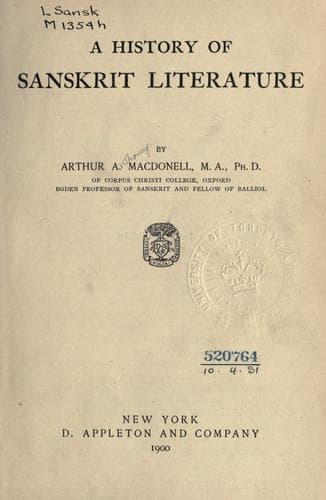
A History of Sanskrit LiteratureMacdonell, Arthur Anthony
History
A History of Sanskrit Literature
Macdonell, Arthur Anthony
Sanskrit literature -- History and criticism
The first book is an introduction, dealing with the principles
of grammar and exegesis. The second and third elucidate certain
points in the synonymous nighantus; Books IV.-VI. comment on the
fourth section, and VII.-XII. on the fifth. The Nirukta, besides
being very important from the point of view of exegesis and grammar,
is highly interesting as the earliest specimen of Sanskrit prose of
the classical type, considerably earlier than Panini himself. Yaska
already uses essentially the same grammatical terminology as Panini,
employing, for instance, the same words for root (dhatu), primary,
and secondary suffixes. But he must have lived a long time before
Panini; for a considerable number of important grammarians' names are
mentioned between them. Yaska must, therefore, go back to the fifth
century, and undoubtedly belongs to the beginning of the Sutra period.
One point of very great importance proved by the Nirukta is that the
Rigveda had a very fixed form in Yaska's time, and was essentially
identical with our text. His deviations are very insignificant. Thus
in one passage (X. 29. I) he reads vayó as one word, against va
yó as two words in Çakalya's Pada text. Yaska's paraphrases show
that he also occasionally differed from the Samhita text, though
the quotations themselves from the Rigveda have been corrected so
as to agree absolutely with the traditional text. But these slight
variations are probably due to mistakes in the Nirukta rather than
to varieties of reading in the Rigveda. There are a few insignificant
deviations of this kind even in Sayana, but they are always manifestly
oversights on the part of the commentator.
To the Sutras is attached a very extensive literature of Pariçishtas
or "supplements," which seem to have existed in all the Vedic
schools. They contain details on matters only touched upon in the
Sutras, or supplementary information about subjects not dealt with at
all by them. Thus, there is the Açvalayana Grihya-pariçishta, in four
chapters, connected with the Rigveda. The Gobhila samgraha-pariçishta
is a compendium of Grihya practices in general, with a special
leaning towards magical rites, which came to be attached to the
Samaveda. Closely related to, and probably later than this work, is
the Karma-pradipa ("lamp of rites"), also variously called sama-grihya-
or chhandogyagrihya-pariçishta, chhandoga-pariçishta, Gobhila-smriti,
attributed to the Katyayana of the White Yajurveda or to Gobhila. It
deals with the same subjects, though independently, as the Grihya
samgraha, with which it occasionally agrees in whole çlokas.
Public-domain text, read in full here on John Shaqi.
Reviews
Reviews
No reviews yet
Be the first to share your thoughts on this work.
Elsewhere in the archive
Join the Discussion
Join the discussion
Sign in to leave a comment or review.
Sign InorCreate an account