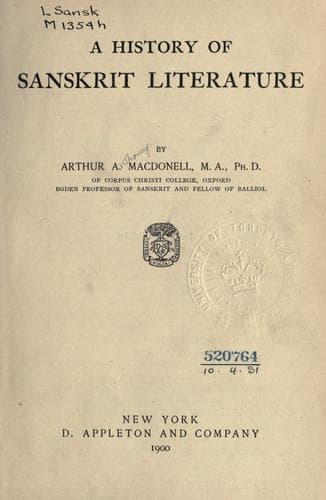
A History of Sanskrit LiteratureMacdonell, Arthur Anthony
History
A History of Sanskrit Literature
Macdonell, Arthur Anthony
Sanskrit literature -- History and criticism
The Brahmans knew how to utilise the great influence of the old epic
tradition by gradually incorporating didactic matter calculated to
impress upon the people, and especially on kings, the doctrines
of the priestly caste. It thus at last assumed the character of
a vast treatise on duty (dharma), in which the divine origin and
immutability of Brahman institutions, the eternity of the caste system,
and the subordination of all to the priests, are laid down. When the
Mahabharata attributes its origin to Vyasa, it implies a belief in a
final redaction, for the name simply means "Arranger." Dahlmann has
recently put forward the theory that the great epic was a didactic
work from the very outset; this view, however, appears to be quite
irreconcilable with the data of the poem, and is not likely to find
any support among scholars.
What evidence have we as to when the Mahabharata attained to the form
in which we possess it? There is an inscription in a land grant dating
from 462 A.D. or at the latest 532 A.D., which proves incontrovertibly
that the epic about 500 A.D. was practically of exactly the same length
as it is stated to have in the survey of contents (anukramanika) given
in Book I., and as it actually has now; for it contains the following
words: "It has been declared in the Mahabharata, the compilation
embracing 100,000 verses, by the highest sage, Vyasa, the Vyasa of
the Vedas, the son of Paraçara." This quotation at the same time
proves that the epic at that date included the very long 12th and
13th, as well as the extensive supplementary book, the Harivamça,
without any one of which it would have been impossible to speak even
approximately of 100,000 verses. There are also several land grants,
dated between 450 and 500 A.D., and found in various parts of India,
which quote the Mahabharata as an authority teaching the rewards of
pious donors and the punishments of impious despoilers. This shows
that in the middle of the fifth century it already possessed the
same character as at present, that of a Smriti or Dharmaçastra. It
is only reasonable to suppose that it had acquired this character
at least a century earlier, or by about 350 A.D. Further research
in the writings of the Northern Buddhists and their dated Chinese
translations will probably enable us to put this date back by some
centuries. We are already justified in considering it likely that
the great epic had become a didactic compendium before the beginning
of our era. In any case, the present state of our knowledge entirely
disproves the suggestions put forward by Prof. Holtzmann in his work
on the Mahabharata, that the epic was turned into a Dharmaçastra by
the Brahmans after 900 A.D., and that whole books were added at this
late period.
Public-domain text, read in full here on John Shaqi.
Reviews
Reviews
No reviews yet
Be the first to share your thoughts on this work.
Elsewhere in the archive
Join the Discussion
Join the discussion
Sign in to leave a comment or review.
Sign InorCreate an account