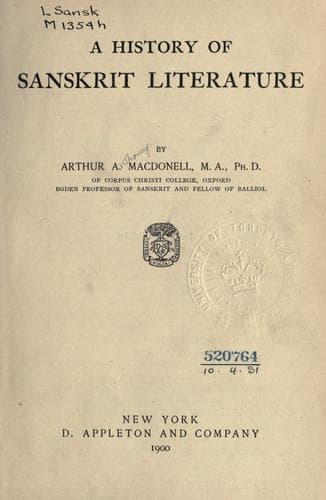
A History of Sanskrit LiteratureMacdonell, Arthur Anthony
History
A History of Sanskrit Literature
Macdonell, Arthur Anthony
Sanskrit literature -- History and criticism
Closely connected with the Mahabharata is a distinct class of eighteen
epic works, didactic in character and sectarian in purpose, going by
the name of Purana. The term purana is already found in the Brahmanas
designating cosmogonic inquiries generally. It is also used in the
Mahabharata somewhat vaguely to express "ancient legendary lore,"
implying didactic as well as narrative matter, and pointing to an
old collection of epic stories. One passage of the epic (I. v. 1)
describes purana as containing stories of the gods and genealogies of
the sages. In Book XVIII., as well as in the Harivamça, mention is even
made of eighteen Puranas, which, however, have not been preserved; for
those known to us are all, on the whole, later than the Mahabharata,
and for the most part derive their legends of ancient days from the
great epic itself. Nevertheless they contain much that is old; and it
is not always possible to assume that the passages they have in common
with the Mahabharata and Manu have been borrowed from those works. They
are connected by many threads with the old law-books (smritis) and
the Vedas, representing probably a development of older works of
the same class. In that part of their contents which is peculiar to
them, the Puranas agree so closely, being often verbally identical
for pages, that they must be derived from some older collection as
a common source. Most of them are introduced in exactly the same
way as the Mahabharata, Ugraçravas, the son of Lomaharshana, being
represented as relating their contents to Çaunaka on the occasion
of a sacrifice in the Naimisha forest. The object of most of these
legendary compilations is to recommend the sectarian cult of Vishnu,
though some of them favour the worship of Çiva.
Besides cosmogony, they deal with mythical descriptions of the earth,
the doctrine of the cosmic ages, the exploits of ancient gods, saints,
and heroes, accounts of the Avatars of Vishnu, the genealogies of the
Solar and Lunar race of kings, and enumerations of the thousand names
of Vishnu or of Çiva. They also contain rules about the worship of
the gods by means of prayers, fastings, votive offerings, festivals,
and pilgrimages.
The Garuda, as well as the late and unimportant Agni Purana,
practically constitute abstracts of the Mahabharata and the Harivamça.
The Vayu, which appears to be one of the oldest, coincides in part of
its matter with the Mahabharata, but is more closely connected with
the Harivamça, the passage which deals with the creation of the world
often agreeing verbatim with the corresponding part of the latter poem.
Public-domain text, read in full here on John Shaqi.
Reviews
Reviews
No reviews yet
Be the first to share your thoughts on this work.
Elsewhere in the archive
Join the Discussion
Join the discussion
Sign in to leave a comment or review.
Sign InorCreate an account