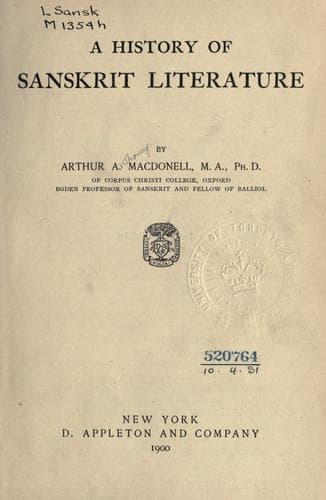
A History of Sanskrit LiteratureMacdonell, Arthur Anthony
History
A History of Sanskrit Literature
Macdonell, Arthur Anthony
Sanskrit literature -- History and criticism
The relationship of the Matsya Purana to the great epic and its
supplementary book as sources is similarly intimate. It is introduced
with the story of Manu and the Fish (Matsya). The Kurma, besides giving
an account of the various Avatars of Vishnu (of which the tortoise or
kurma is one), of the genealogies of gods and kings, as well as other
matters, contains an extensive account of the world in accordance with
the accepted cosmological notions of the Mahabharata and of the Puranas
in general. The world is here represented as consisting of seven
concentric islands separated by different oceans. The central island,
with Mount Meru in the middle, is Jambu-dvipa, of which Bharata-varsha,
the "kingdom of the Bharatas," or India, is the main division.
The Markandeya, which expressly recognises the priority of the
Mahabharata, is so called because it is related by the sage Markandeya
to explain difficulties suggested by the epic, such as, How could
Krishna become a man? Its leading feature is narrative and it is the
least sectarian of the Puranas.
The extensive Padma Purana, which contains a great many stones
agreeing with those of the Mahabharata, is, on the other hand,
strongly Vishnuite in tone. Yet this, as well as the Markandeya,
expressly states the doctrine of the Tri-murti or Trinity, that Brahma,
Vishnu, and Çiva are only one being. This doctrine, already to be
found in the Harivamça, is not so prominent in post-Vedic literature
as is commonly supposed. It is interesting to note that the story
of Rama, as told in the Padma Purana, follows not only the Ramayana
but also Kalidasa's account in the Raghuvamça, with which it often
agrees literally. Again, the story of Çakuntala is related, not in
accordance with the Mahabharata, but with Kalidasa's drama.
The Brahma-vaivarta Purana is also strongly sectarian in favour of
Vishnu in the form of Krishna. It is to be noted that both here and
in the Padma Purana an important part is played by Krishna's mistress
Radha, who is unknown to the Harivamça, the Vishnu, and even the
Bhagavata Purana.
The Vishnu Purana, which very often agrees with the Mahabharata in
its subject-matter, corresponds most closely to the Indian definition
of a Purana, as treating of the five topics of primary creation,
secondary creation, genealogies of gods and patriarchs, reigns of
various Manus, and the history of the old dynasties of kings.
The Bhagavata Purana, which consists of about 18,000 çlokas, derives
its name from being dedicated to the glorification of Bhagavata or
Vishnu. It is later than the Vishnu, which it presupposes, probably
dating from the thirteenth century. It exercises a more powerful
influence in India than any other Purana. The most popular part is
the tenth book, which narrates in detail the history of Krishna,
and has been translated into perhaps every one of the vernacular
languages of India.
Public-domain text, read in full here on John Shaqi.
Reviews
Reviews
No reviews yet
Be the first to share your thoughts on this work.
Elsewhere in the archive
Join the Discussion
Join the discussion
Sign in to leave a comment or review.
Sign InorCreate an account