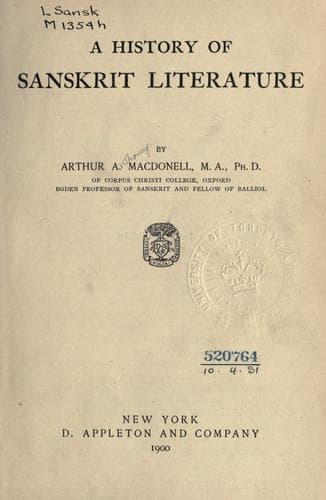
A History of Sanskrit LiteratureMacdonell, Arthur Anthony
History
A History of Sanskrit Literature
Macdonell, Arthur Anthony
Sanskrit literature -- History and criticism
Other Vishnuite Puranas of a late date are the Brahma, the Naradiya,
the Vamana, and the Varaha, the latter two called after the Dwarf
and the Boar incarnations of Vishnu.
Those which specially favour the cult of Çiva are the Skanda, the Çiva,
the Linga, and the Bhavishya or Bhavishyat Puranas. The latter two
contain little narrative matter, being rather ritual in character. A
Bhavishyat Purana is already mentioned in the Apastamba Dharma Sutra.
Besides these eighteen Puranas there is also an equal number of
secondary works of the same class called Upa-puranas, in which the
epic matter has become entirely subordinate to the ritual element.
THE RAMAYANA.
Though there is, as we shall see, good reason for supposing that
the original part of the Ramayana assumed shape at a time when the
Mahabharata was still in a state of flux, we have deferred describing
it on account of its connection with the subsequent development of
epic poetry in Sanskrit literature.
In its present form the Ramayana consists of about 24,000 çlokas,
and is divided into seven books. It has been preserved in three
distinct recensions, the West Indian (A), the Bengal (B), and the
Bombay (C). About one-third of the çlokas in each recension occurs
in neither of the other two. The Bombay recension has in most cases
preserved the oldest form of the text; for, as the other two arose
in the centres of classical Sanskrit literature, where the Gauda
and the Vaidarbha styles of composition respectively flourished, the
irregularities of the epic language have been removed in them. The
Ramayana was here treated as a regular kavya or artificial epic, a
fate which the Mahabharata escaped because it early lost its original
character, and came to be regarded as a didactic work. These two later
recensions must not, however, be looked upon as mere revisions of the
Bombay text. The variations of all three are of such a kind that they
can for the most part be accounted for only by the fluctuations of oral
tradition among the professional reciters of the epic, at the time
when the three recensions assumed definite shape in different parts
of the country by being committed to writing. After having been thus
fixed, the fate of each of these recensions was of course similar to
that of any other text. They appear to go back to comparatively early
times. For quotations from the Ramayana occurring in works that belong
to the eighth and ninth centuries A.D. show that a recension allied to
the present C, and probably another allied to the present A, existed at
that period. Moreover, Kshemendra's poetical abstract of the epic, the
Ramayana-kathasara-manjari, which follows the contents of the original
step by step, proves that its author used A, and perhaps B also, in
the middle of the eleventh century. Bhoja, the composer of another
epitome, the Ramayana-champu, probably used C in the same century.
Public-domain text, read in full here on John Shaqi.
Reviews
Reviews
No reviews yet
Be the first to share your thoughts on this work.
Elsewhere in the archive
Join the Discussion
Join the discussion
Sign in to leave a comment or review.
Sign InorCreate an account