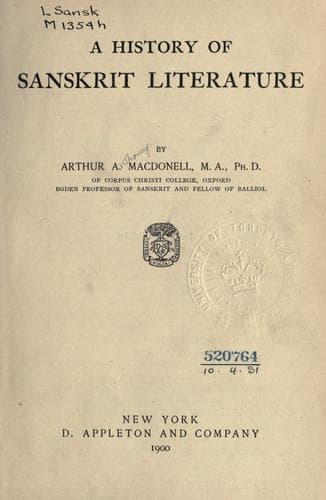
A History of Sanskrit LiteratureMacdonell, Arthur Anthony
History
A History of Sanskrit Literature
Macdonell, Arthur Anthony
Sanskrit literature -- History and criticism
The Chaura-panchaçika, or "Fifty Stanzas of the Thief," is a
lyrical poem which contains many beauties. Its author was the
Kashmirian Bilhana, who belongs to the later half of the eleventh
century. According to the romantic tradition, this poet secretly
enjoyed the love of a princess, and when found out was condemned
to death. He thereupon composed fifty stanzas, each beginning with
the words "Even now I remember," in which he describes with glowing
enthusiasm the joys of love he had experienced. Their effect on the
king was so great that he forgave the poet and bestowed on him the
hand of his daughter.
The main bulk of the lyrical creations of mediæval India are not
connected poems of considerable length, but consist of that miniature
painting which, as with a few strokes, depicts an amatory situation
or sentiment in a single stanza of four lines. These lyrics are in
many respects cognate to the sententious poetry which the Indians
cultivated with such eminent success. Bearing evidence of great
wealth of observation and depth of feeling, they are often drawn by
a master-hand. Many of them are in matter and form gems of perfect
beauty. Some of their charm is, however, lost in translation owing
to the impossibility of reproducing the elaborate metres employed in
the original. Several Sanskrit poets composed collections of these
miniature lyrics.
The most eminent of these authors is Bhartrihari, grammarian,
philosopher, and poet in one. Only the literary training of India
could make such a combination possible, and even there it has hardly
a parallel. Bhartrihari lived in the first half of the seventh
century. The Chinese traveller I Tsing, who spent more than twenty
years in India at the end of that century, records that, having
turned Buddhist monk, the poet again became a layman, and fluctuated
altogether seven times between the monastery and the world. Bhartrihari
blamed himself for, but could not overcome, his inconstancy. He wrote
three centuries of detached stanzas. Of the first and last, which are
sententious in character, there will be occasion to say something
later. Only the second, entitled Çringara-çataka, or "Century of
Love," deals with erotic sentiment. Here Bhartrihari, in graceful and
meditative verse, shows himself to be well acquainted both with the
charms of women and with the arts by which they captivate the hearts
of men. Who, he asks in one of these miniature poems, is not filled
with yearning thoughts of love in spring, when the air swoons with
the scent of the mango blossom and is filled with the hum of bees
intoxicated with honey? In another he avers that none can resist the
charms of lotus-eyed maidens, not even learned men, whose utterances
about renouncing love are mere idle words. The poet himself laments
that, when his beloved is away, the brightness goes out of his life--
Public-domain text, read in full here on John Shaqi.
Reviews
Reviews
No reviews yet
Be the first to share your thoughts on this work.
Elsewhere in the archive
Join the Discussion
Join the discussion
Sign in to leave a comment or review.
Sign InorCreate an account