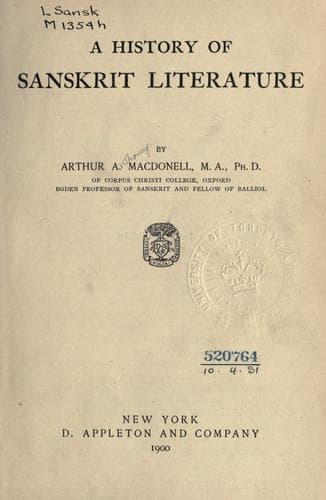
A History of Sanskrit LiteratureMacdonell, Arthur Anthony
History
A History of Sanskrit Literature
Macdonell, Arthur Anthony
Sanskrit literature -- History and criticism
Beside the lamp, the flaming hearth,
In light of sun or moon and stars,
Without my dear one's lustrous eyes
This world is wholly dark to me.
At the same time he warns the unwary against reflecting over-much on
female beauty--
Let not thy thoughts, O Wanderer,
Roam in that forest, woman's form:
For there a robber ever lurks,
Ready to strike--the God of Love.
In another stanza the Indian Cupid appears as a fisherman, who,
casting on the ocean of this world a hook called woman, quickly
catches men as fishes eager for the bait of ruddy lips, and bakes
them in the fire of love.
Strange are the contradictions in which the poet finds himself involved
by loving a maiden--
Remembered she but causes pain;
At sight of her my madness grows;
When touched, she makes my senses reel:
How, pray, can such an one be loved?
So towards the end of the Century the poet's heart begins to turn
from the allurements of love. "Cease, maiden," he exclaims, "to cast
thy glances on me: thy trouble is in vain. I am an altered man; youth
has gone by and my thoughts are bent on the forest; my infatuation is
over, and the whole world I now account but as a wisp of straw." Thus
Bhartrihari prepares the way for his third collection, the "Century
of Renunciation."
A short but charming treasury of detached erotic verses is the
Çringara-tilaka, which tradition attributes to Kalidasa. In its
twenty-three stanzas occur some highly imaginative analogies, worked
out with much originality. In one of them, for instance, the poet
asks how it comes that a maiden, whose features and limbs resemble
various tender flowers, should have a heart of stone. In another he
compares his mistress to a hunter--
This maiden like a huntsman is;
Her brow is like the bow he bends;
Her sidelong glances are his darts;
My heart's the antelope she slays.
The most important lyrical work of this kind is the Amaruçataka,
or "Hundred stanzas of Amaru." The author is a master in the art of
painting lovers in all their moods, bliss and dejection, anger and
devotion. He is especially skilful in depicting the various stages of
estrangement and reconciliation. It is remarkable how, with a subject
so limited, in situations and emotions so similar, the poet succeeds
in arresting the attention with surprising turns of thought, and
with subtle touches which are ever new. The love which Amaru as well
as other Indian lyrists portrays is not of the romantic and ideal,
but rather of the sensuous type. Nevertheless his work often shows
delicacy of feeling and refinement of thought. Such, for instance,
is the case when he describes a wife watching in the gloaming for
the return of her absent husband.
Public-domain text, read in full here on John Shaqi.
Reviews
Reviews
No reviews yet
Be the first to share your thoughts on this work.
Elsewhere in the archive
Join the Discussion
Join the discussion
Sign in to leave a comment or review.
Sign InorCreate an account