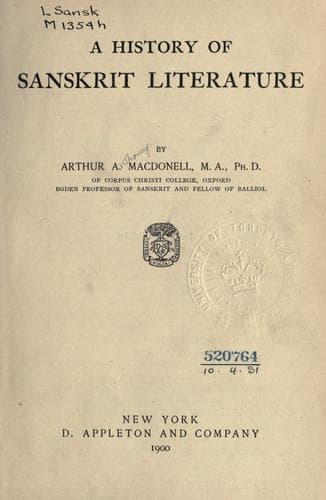
A History of Sanskrit LiteratureMacdonell, Arthur Anthony
History
A History of Sanskrit Literature
Macdonell, Arthur Anthony
Sanskrit literature -- History and criticism
If not actually a Buddhistic work, the Panchatantra must be derived
from Buddhistic sources. This follows from the fact that a number of
its fables can be traced to Buddhistic writings, and from the internal
evidence of the book itself. Apologues and fables were current among
the Buddhists from the earliest times. They were ascribed to Buddha,
and their sanctity increased by identifying the best character in
any story with Buddha himself in a previous birth. Hence such tales
were called Jatakas, or "Birth Stories." There is evidence that a
collection of stories under that name existed as early as the Council
of Vesali, about 380 B.C.; and in the fifth century A.D. they assumed
the shape they now have in the Pali Sutta-pitaka. Moreover, two
Chinese encylopædias, the older of which was completed in 668 A.D.,
contain a large number of Indian fables translated into Chinese,
and cite no fewer than 202 Buddhist works as their sources. In its
present form, however, the Panchatantra is the production of Brahmans,
who, though they transformed or omitted such parts as betrayed animus
against Brahmanism, have nevertheless left uneffaced many traces of
the Buddhistic origin of the collection. Though now divided into only
five books, it is shown by the evidence of the oldest translation to
have at one time embraced twelve. What its original name was we cannot
say, but it may not improbably have been called after the two jackals,
Karataka and Damanaka, who play a prominent part in the first book;
for the title of the old Syriac version is Kalilag and Damnag, and
that of the Arabic translation Kalilah and Dimnah.
Originally the Panchatantra was probably intended to be a manual for
the instruction of the sons of kings in the principles of conduct
(niti), a kind of "Mirror of Princes." For it is introduced with the
story of King Amaraçakti of Mahilaropya, a city of the south, who
wishes to discover a scholar capable of training his three stupid
and idle sons. He at last finds a Brahman who undertakes to teach
the princes in six months enough to make them surpass all others
in knowledge of moral science. This object he duly accomplishes by
composing the Panchatantra and reciting it to the young princes.
Public-domain text, read in full here on John Shaqi.
Reviews
Reviews
No reviews yet
Be the first to share your thoughts on this work.
Elsewhere in the archive
Join the Discussion
Join the discussion
Sign in to leave a comment or review.
Sign InorCreate an account