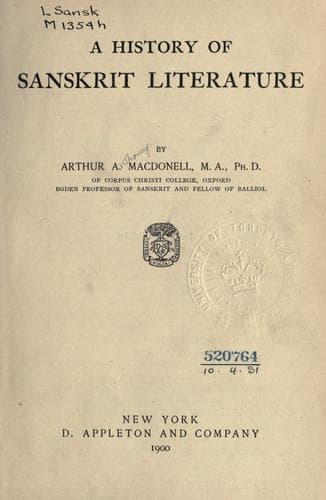
A History of Sanskrit LiteratureMacdonell, Arthur Anthony
History
A History of Sanskrit Literature
Macdonell, Arthur Anthony
Sanskrit literature -- History and criticism
The framework of the first book, entitled "Separation of Friends," is
the story of a bull and a lion, who are introduced to one another in
the forest by two jackals and become fast friends. One of the jackals,
feeling himself neglected, starts an intrigue by telling both the
lion and the bull that each is plotting against the other. As a result
the bull is killed in battle with the lion, and the jackal, as prime
minister of the latter, enjoys the fruits of his machinations. The
main story of the second book, which is called "Acquisition of
Friends," deals with the adventures of a tortoise, a deer, a crow,
and a mouse. It is meant to illustrate the advantages of judicious
friendships. The third book, or "The War of the Crows and the Owls,"
points out the danger of friendship concluded between those who are old
enemies. The fourth book, entitled "Loss of what has been Acquired,"
illustrates, by the main story of the monkey and the crocodile, how
fools can be made by flattery to part with their possessions. The fifth
book, entitled "Inconsiderate Action," contains a number of stories
connected with the experiences of a barber, who came to grief through
failing to take all the circumstances of the case into consideration.
The book is pervaded by a quaint humour which transfers, to the animal
kingdom all sorts of human action. Thus animals devote themselves
to the study of the Vedas and to the practice of religious rites;
they engage in disquisitions about gods, saints, and heroes; or
exchange views regarding subtle rules of ethics; but suddenly their
fierce animal nature breaks out. A pious cat, for instance, called
upon to act as umpire in a dispute between a sparrow and a monkey,
inspires such confidence in the litigants, by a long discourse on the
vanity of life and the supreme importance of virtue, that they come
close up in order to hear better the words of wisdom. In an instant he
seizes one of the disputants with his claws, the other with his teeth,
and devours them both. Very humorous is the story of the conceited
musical donkey. Trespassing one moonlight night in a cucumber field,
he feels impelled to sing, and answers the objections of his friend
the jackal by a lecture on the charms of music. He then begins to bray,
arouses the watchmen, and receives a sound drubbing.
With abundant irony and satire the most various human vices are
exposed, among others the hypocrisy and avarice of Brahmans, the
intriguing character of courtiers, and the faithlessness of women. A
vigorous popular spirit of reaction against Brahman pretensions here
finds expression, and altogether a sound and healthy view of life
prevails, forming a refreshing contrast to the exaggeration found in
many branches of Indian literature.
The following translation of a short fable from the first book may
serve as a specimen of the style of the Panchatantra.
Public-domain text, read in full here on John Shaqi.
Reviews
Reviews
No reviews yet
Be the first to share your thoughts on this work.
Elsewhere in the archive
Join the Discussion
Join the discussion
Sign in to leave a comment or review.
Sign InorCreate an account